Adım Adım Amasya

Monuments of the city · Mosque

Hızır Paşa Mosque

Its door is not on the north but on the east. This was not a choice but a solution forced by the ground — and one of the things that make the building the only one of its kind.

AH 870 · 1465–1466 Zaviye-type (inverted-T) mosque North of the station
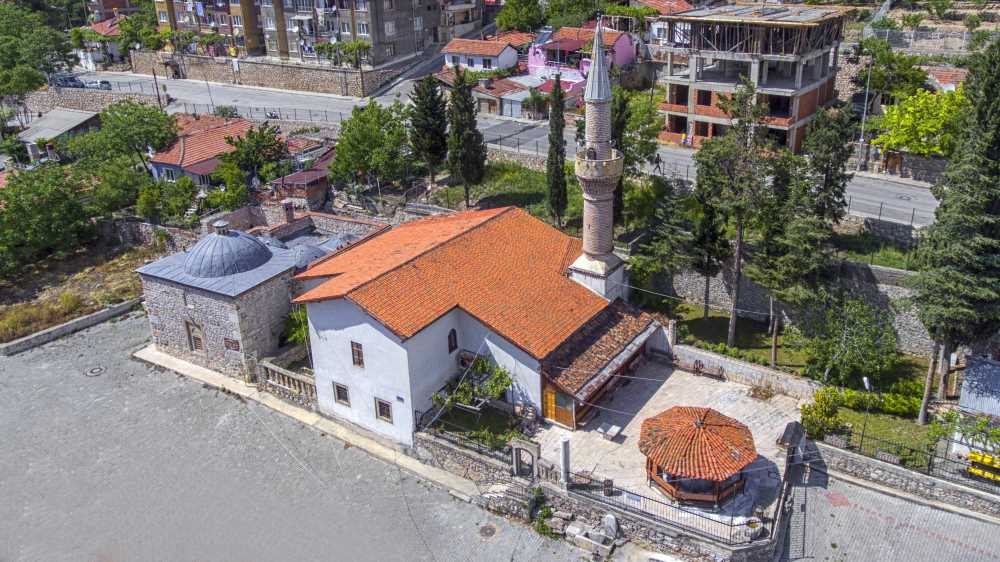
Hızır Paşa Mosque: a mosque with rubble-stone walls and a tiled roof on sloping ground
Hızır Paşa Mosque. Kültür Portalı (Kültürel Miras Boyutuyla Amasya, Photo 9).

📜 What do the documents say?

The building stands on the hill north of Amasya railway station and was built by Hayrüddin Hızır Paşa, brother of Yörgüç Paşa.1

It is one of the important examples of zaviye-type mosques with a flat timber ceiling; it has a timber ceiling and a tiled roof.1 Its walls are of rubble stone.2

What is a zaviye-type (inverted-T plan) mosque? It is a plan type with the main prayer space in the middle and separate sections on either side. In Amasya the Bayezid Paşa and Yörgüç Paşa mosques are also of this type; it found its most developed form in the Yeşil Cami (Green Mosque) in Bursa.3

How old is this mosque?

The book dates the building to the “14th century”1 and takes this from the Yurt Ansiklopedisi.2 The other sources we have, however, agree on the 15th century. This page has followed the majority; but it does not delete what the book says either.

SourceDate givenWhat it says
Kani KuzucularAH 870 (1465) “North of the Ok Meydanı… this zaviye and bathhouse, built in AH 870 (1465) by Hızır Paşa, brother of Yörgüç Paşa…”3
Amasya Şehir Rehberi1466 “It was built in 1466 by Hayrüddin Hızır Paşa, brother of Yörgüç Paşa.”4
Zeynep Kemaloğlu1466 Gives the same year and counts the building “among our unique works”.5
Yurt Ansiklopedisi — architecture section15th century “The Hızır Paşa Mosque, 15th c., which has been able to come down to the present in its original state…”2
Yurt Ansiklopedisi — entry section14th century “It was built in the 14th c. by Hayrüddin Hızır Paşa, brother of Yörgüç Paşa.” This is the sentence the book relies on.2

What is striking is this: the source that says “14th century” is the encyclopedia itself — and on another page that same encyclopedia gives the 15th century for the same mosque.2 The source contradicts itself.

Moreover, the founder's identity also points to the date: Hayrüddin Hızır Paşa was the brother of Yörgüç Paşa.1, 3, 4, 5 Yörgüç Paşa was a 15th-century figure; his buildings in Amasya are dated to 1428–1430. It does not seem possible that his brother's mosque was built a century earlier.

That is why the Key facts give AH 870 (1465–1466). The Hijri year 870 corresponds to the end of 1465 and most of 1466 AD; that is why some sources say 1465 and others 1466.

🏛️ The only one of its kind

Most zaviye-type mosques are covered with domes. The Hızır Paşa Mosque, however, is the only example with a timber ceiling among the zaviye-type mosques that have come down in their original state.6 The Yurt Ansiklopedisi says the same: the only example of this type with a timber ceiling.2

The main prayer space lies on the axis; to the east and west there are two sections, separated from one another by a large arch. While the central space is covered by a timber ceiling resting on bingi and a tiled roof, the side spaces are domed.5

Why is the door on the east? The ground slopes. On the south side a platform was formed together with a wall, while the north of the building merges with the hillside. Because it could not be entered from the north, the entrance was placed on the east, over the side space.2, 4, 5 The ablution fountain was also placed on this façade.4 That the entrance façade lies over a side space is another feature that sets the building apart from the other examples of this type.2

Inside there are moulded timber brackets and painted beams and ceiling panels. The woodwork of the muezzin's gallery, the maksures (screened enclosures), the window shutters and the minbar is the building's most striking decorative feature.6
What is left of a complex?

There was not just a mosque here. There was a complex (külliye) made up of a mosque, a bathhouse, a madrasa and an ablution fountain.4

🕌Mosquestanding
♨️Bathhousestanding
📚Madrasagone
💧Ablution fountainnot the original

Only one writer described the madrasa. Kuzucular records that the madrasa is known in the form described by H. Hüsameddin, but that the building has disappeared.3 So everything we know about that madrasa today lies on the pages of a book.

While you are there, look for

Key facts

Built
AH 870 — AD 1465–14663, 4, 5 (the book says “14th century”1; see the table above)
Commissioned by
Hayrüddin Hızır Paşa — brother of Yörgüç Paşa1, 3, 4
Plan
Zaviye type (inverted T); timber ceiling in the centre, domes at the sides1, 5
Material
Rubble stone2
Entrance
From the east façade — because of the slope of the ground2, 4, 5
The complex
Mosque, bathhouse, madrasa, ablution fountain; today the mosque and the bathhouse stand4
Distinctive feature
The only zaviye-type mosque with a timber ceiling2, 6
Location
40.657347, 35.8135441 — verified from an external source
In the book
Kültürel Miras Boyutuyla Amasya, p. 37

📍 Open on the map

Sources

  1. Kültürel Miras Boyutuyla Amasya (Amasya: Amasya Üniversitesi, BAP Projesi SEB-BAP25-0233, 2026), 37.
  2. “Amasya”, Türkiye İl İl: Dünü, Bugünü, Yarını — Yurt Ansiklopedisi, C. 1 (İstanbul: Anadolu Yayıncılık, 1982), 497. — The entry the book relies on. Note: in the architecture section of the same encyclopedia the mosque is given as “15th c.”; in the entry section it says “14th c.”.
  3. Kani Kuzucular, Amasya Kentinin Fiziksel Yapısının Tarihsel Gelişimi (İstanbul: İstanbul Teknik Üniversitesi Fen Bilimleri Enstitüsü, Doktora Tezi, 1994), 63-64. — p. 64, “Hızır Paşa Cami, Medrese ve Hamamı”: the date AH 870 (1465), the location north of the Ok Meydanı and the statement that the madrasa described by H. Hüsameddin has disappeared. p. 63: the examples in Amasya of the zaviye (“winged” / “inverted-T”) plan type and its relation to the Yeşil Cami in Bursa.
  4. Amasya Valiliği, Amasya Şehir Rehberi (Amasya: Amasya Valiliği, 2013), 33-34. — The date 1466, the units of the complex and the reason the entrance was moved to the east.
  5. Zeynep Kemaloğlu, Amasya Mihrabları (Kayseri: Erciyes Üniversitesi Sosyal Bilimler Enstitüsü, Yüksek Lisans Tezi, 2016), 98. — The date 1466 and the description of the plan: the main space on the axis, the side sections separated by an arch, the timber ceiling and the domed side spaces.
  6. Ersel Oltulu, Amasya'nın Anıtsal Eserleri ve Hızır Paşa Külliyesi Restitüsyon ve Koruma Önerisi (İstanbul: Yıldız Teknik Üniversitesi Fen Bilimleri Enstitüsü, Yüksek Lisans Tezi, 2006), 123. — The statement that “it is the only example with a timber ceiling among the zaviye-type mosques”, and the woodwork of the interior.