Adım Adım Amasya

Monuments of the city · Mosque

Pir Mehmet Çelebi Mosque

It has no inscription. So no one can give its date for certain — and it goes by four different names. Establishing a building's identity is not always easy.

15th century Dere neighbourhood South bank
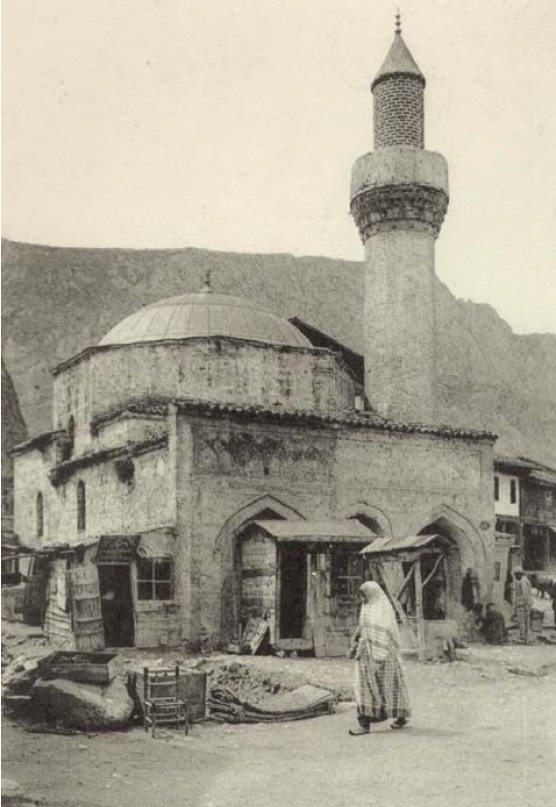
Pir Mehmet Çelebi Mosque: single-domed prayer hall and three-section late-comers' portico
Pir Mehmet Çelebi Mosque. Perrot Archive (Kültürel Miras Boyutuyla Amasya, Photo 13).

Four names, one mosque

As you go through the sources you will come across this building under four different names. They are all the same mosque; each name tells something different.

Pir Mehmet Çelebi CamiiAfter its founder1, 2
Murad CamiiIn the sources and among the people1, 3
Pazar CamiiIn A. Gabriel's study of 19341, 3
Sığır Pazarı CamiiAfter its location, the Cattle Market2

📜 What do the documents say?

The mosque is in central Amasya, within the Dere neighbourhood, on Mustafa Kemal Paşa Avenue.1, 3 Kuzucular describes the spot in more detail: just below Yassı Kaya, on the bank of the Çakallar Suyu, in the place called Sığır Pazarı (the Cattle Market).2

The building was commissioned by Pir Mehmed Çelebi, son of Hoca Süleyman Çelebi.1 In AH 913 (1507) the mosque's endowments were set in order.1, 2 The book also records that his wife Kamer Hatun endowed a cüzhan — that is, a person charged with reciting the Qur'an — to this building.1

It has no inscription. Since there is no inscription giving the building's exact date, its dating rests on architectural evidence.1 The table below shows where the sources part ways on this.

How do you date a building that has no inscription?

If there is no date on the stone, two ways are left: architectural similarity and archival records. The sources have tried both and arrived at different places.

SourceDate givenWhat it rests on
A. Gabriel (1934), via OltuluFirst half of the 15th century Architectural evidence. Oltulu also writes, separately, that it is “not known when, or by whom, it was built”.3
The bookFirst half of the 15th c. or 15th–16th c. Working from architectural evidence; two ranges are given at once.1
Selim ÖzcanEnd of the 15th century In a table of buildings of the princes' period.4
Kani KuzucularAH 913 (1507) This is not a construction date: it is the year the endowments were set in order. It shows that the building existed by that date at the latest.2

This is not a contradiction but an uncertainty. Because there is no inscription, no one can speak with certainty; each gives a range according to the clue in hand. That is why the Key facts say “15th century” — the narrowest phrase into which all the sources fit.

1507, on the other hand, is a firm cut-off date: that the endowments were set in order that year tells us that the mosque was standing by then at the latest.2

🏛️ What is the building like?

It is a single-domed mosque of a commonly found type. It consists of a square space covered by a small dome, with a late-comers' portico in front, with three openings and closed at the sides.2, 3

The central section of the late-comers' portico is kept narrower, and its opening is spanned by a Bursa arch; the side sections are wider, and pointed arches are used there. The late-comers' portico was built up higher on its north wall, and geometric decoration in brick was worked into this part.3

The body walls are of rubble stone, the minaret is of brick, and the dome is clad in lead.3

How do you get up the minaret? The minaret adjoins the west façade but has no door of its own: it is entered through a door inside the prayer hall.3 So to climb up for the call to prayer, the muezzin first had to go into the mosque.

It has a twin. Kuzucular writes that this mosque is of the same size and the same type as the Kilari Selim Ağa Mosque.2 Seeing the two on the same day shows you what the “standard” neighbourhood mosque of the period looked like.

While you are there, look for

Key facts

Built
15th century — exact date unknown1, 3, 4
Commissioned by
Pir Mehmed Çelebi — son of Hoca Süleyman Çelebi1, 2
Endowments
Set in order in AH 913 (1507)1, 2
Other names
Murad Camii · Pazar Camii · Sığır Pazarı Camii1, 2, 3
Plan
Square prayer hall, single dome, late-comers' portico with three openings2, 3
Material
Rubble stone; minaret of brick, dome clad in lead3
Inscription
None1
Location
40.651498, 35.834005 — verified against OpenStreetMap
In the book
Kültürel Miras Boyutuyla Amasya, p. 41

📍 Open on the map

Sources

  1. Kültürel Miras Boyutuyla Amasya (Amasya: Amasya Üniversitesi, BAP Projesi SEB-BAP25-0233, 2026), 41.
  2. Kani Kuzucular, Amasya Kentinin Fiziksel Yapısının Tarihsel Gelişimi (İstanbul: İstanbul Teknik Üniversitesi Fen Bilimleri Enstitüsü, Doktora Tezi, 1994), 64. — The building's location at Sığır Pazarı, the endowment settlement of AH 913 (1507), its plan, and the statement that it is of the same size and type as the Kilari Mosque.
  3. Ersel Oltulu, Amasya'nın Anıtsal Eserleri ve Hızır Paşa Külliyesi Restitüsyon ve Koruma Önerisi (İstanbul: Yıldız Teknik Üniversitesi Fen Bilimleri Enstitüsü, Yüksek Lisans Tezi, 2006), 56-57. — Record card and architectural description: the three-section late-comers' portico, the Bursa arch, the geometric brick decoration, the minaret entered from inside. Gabriel's name “Pazar Camisi” and his dating to the first half of the 15th century are also here.
  4. Selim Özcan, “Amasya'da Sancakbeyliği Yapan Şehzadeler Döneminde Amasya Şehri”, Amasya Üniversitesi İlahiyat Fakültesi Dergisi 5 (2015), 84. — The table that dates the building to “the end of the 15th century”.