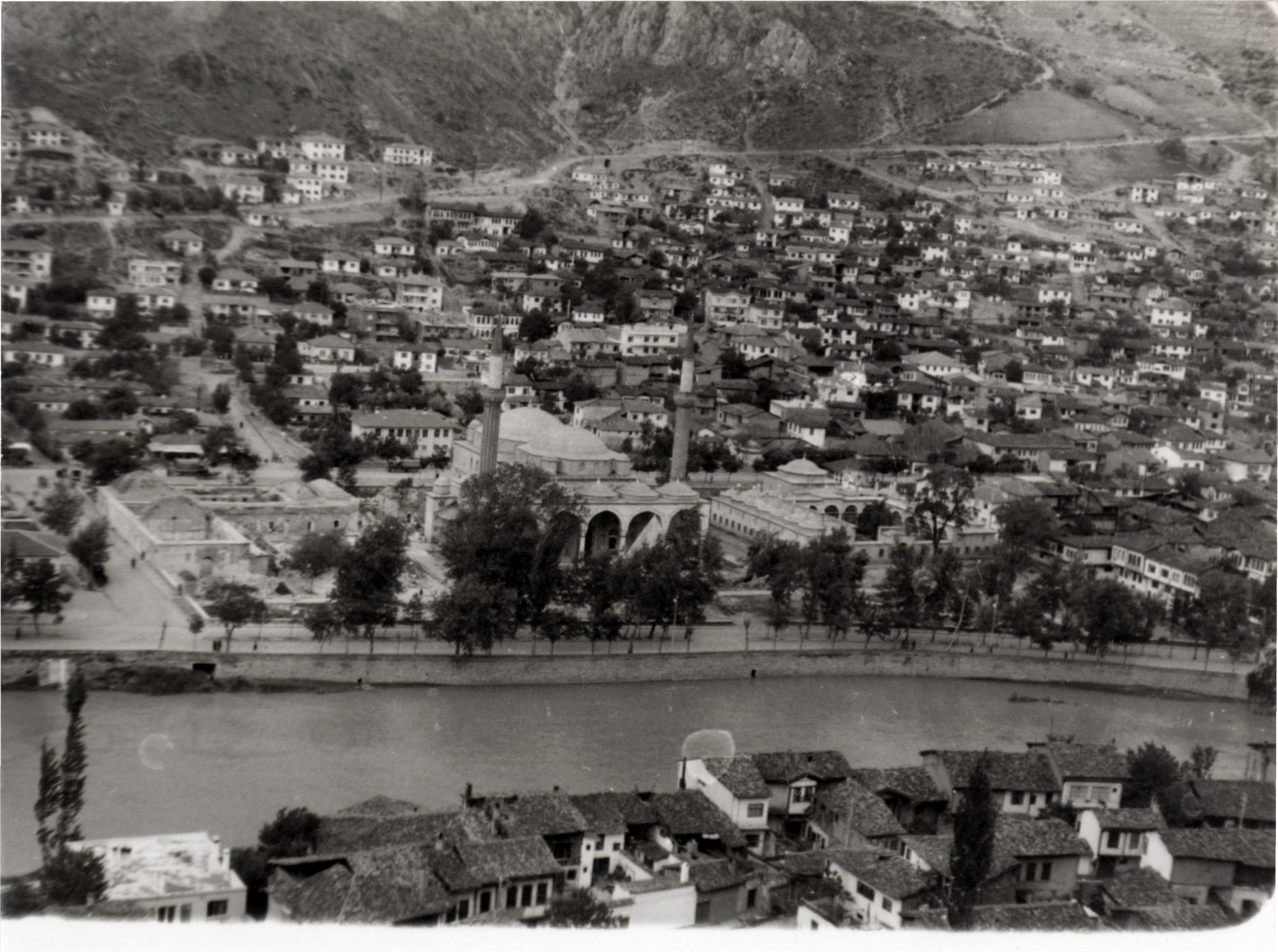
📜 What do the documents say?
The complex was built, on Sultan Bayezid II's instructions, by his son Prince Ahmed, then governor of Amasya.1, 2 According to the mosque's own building inscription, construction began in AH 890 (1485) and was completed in the month of Rajab AH 891 (1486).3
The complex's endowment deed (vakfiye), dated AH 901 (1495–96), has survived. It lists the units as mosque, madrasa, public kitchen (imaret), school and bridge. The bridge on the list is not in Amasya: it stands at Osmancık in Çorum province, over the Kızılırmak.2 The school has not survived.2
The mosque is entered through a monumental portal beneath the five-bayed late-comers' portico; it consists of two square-plan spaces, one after the other. The madrasa to its west is made up of eighteen cells arranged in a U beside the lecture hall.4
Sources that differ. The Hijri date 901 of the endowment deed is converted as 1495 in one source and as 1496 in another.2, 5 Since the Hijri year 901 ran from late 1495 to the middle of 1496, both can be defended.
An older ground — but with caution. Citing the Cumont brothers' interpretation of a text by Gregory of Nyssa, Kuzucular says that in the Roman period a temple of the Mother Goddess stood “probably on the site of the complex or near it”.6 This is an interpretation, not established fact. On the other hand, it is recorded that the same spot was used as a musalla in the early Turkish period.6, 7