📜 What do the documents say?
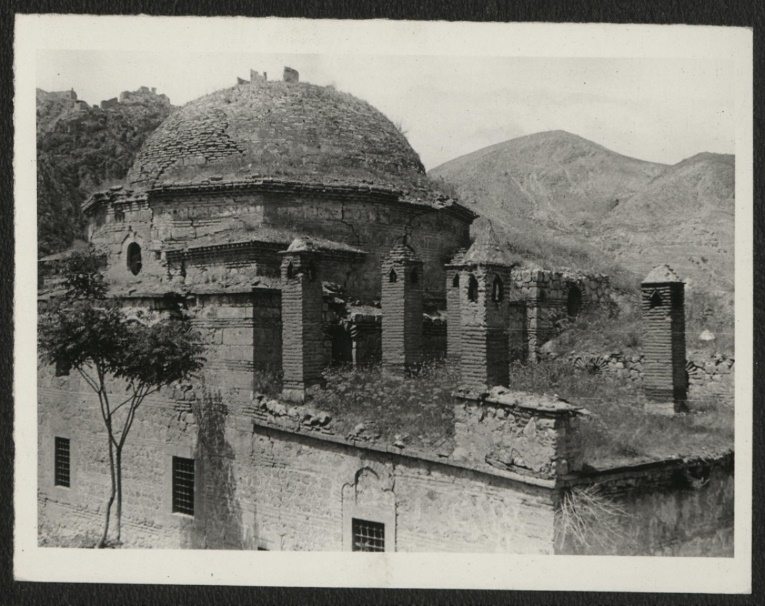
Standing north of Pirler Park, the building was built in 1413 by Yakup
Paşa. Besides serving as a mosque, it was designed as a Halveti lodge
(tekke).
Yakup Paşa built this lodge for the Halveti sheikh and mufti Gümüşlüzade
Abdurrahman Çelebi.2
The building is a complex made up of a small mosque, a tomb and retreat
cells.3 In these respects it departs from classical mosque
architecture and reflects the spatial arrangement of the buildings of Sufi orders.
What is çile? In the Halveti order, a dervish shuts himself away for
a set period in a small cell, devoting himself to worship and the discipline of
the self. The “retreat cells” on this page are those cells; the building takes its
name from them (çilehane: house of retreat).
🗣️ What do the people say?
At the centre of the stories attached to the Çilehane is Şeyh Abdurrahman.
Tuğrul Balaban's collection records more than one memorate about him —
that is, events that people believe really happened.4
The Qur'an on gazelle skin
In the Çilehane Mosque there is a copy of the Holy Qur'an written on gazelle
skin. The imam serving there wants to take it home.
As he goes out of the door, a huge snake rears up in front
of him. He tries going out by the other door — the snake appears there
too. He puts the Qur'an back; he looks, and there is no one at the door. He
picks it up again, and again the snake rears up at the door.
“The one who watches over the Holy Qur'an is Şeyh
Abdurrahman. Because he is the spiritual guardian of that place.”
The sleeping imam's prayer
The imam fails to get up for the dawn prayer; he oversleeps. The congregation
come and say: “Hocam, you led the dawn prayer and went
off. The festival prayer is about to be said — where are you?”
But the hoca had not woken for the dawn prayer. The doors, which had been
locked, had been opened, and the lamps were lit.
The imam understands what has happened but does not let the congregation
notice. While the imam slept, Şeyh Abdurrahman had taken on
his likeness and led the prayer.
This section is a folk narrative, not a document. Memorates are events
that their tellers believe happened; they are given here as they were told.