Adım Adım Amasya

The Princes' Route · Stop 13

Saraydüzü Barracks

The barracks built in place of the princes' palace. The Amasya Circular was drafted here. Then it was pulled down — and rebuilt somewhere else.

1898–1901 National Struggle Reconstruction
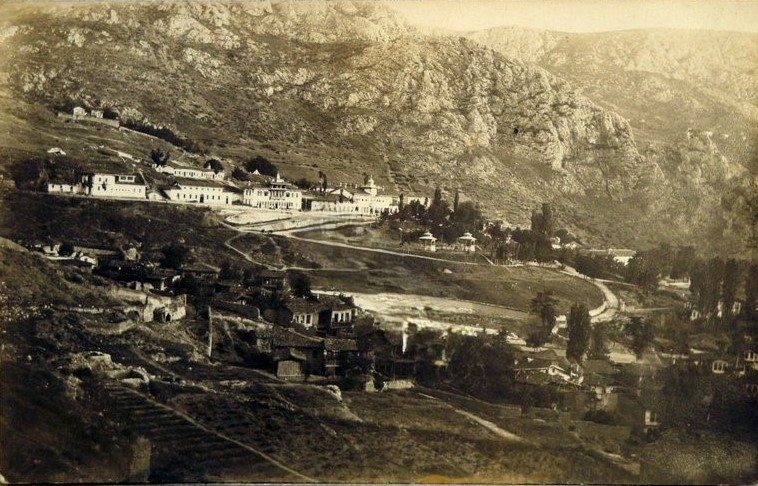
The Saraydüzü Barracks and their surroundings, at the foot of the rocks
The Saraydüzü Barracks. Hüseyin Menç Archive (Kültürel Miras Boyutuyla Amasya, Photo 39).

📜 What do the documents say?

On this spot there was first the Beyler Sarayı (the Palace of the Beys) — one of the most important buildings of the age when princes lived in Amasya, between the 14th and 17th centuries, to gain education and experience of government.1 Despite various repairs, the palace collapsed in the earthquake of 1825–26; repairing it was not thought possible.2

The barracks were built in place of this fallen palace. In the 19th century, under the influence of the Nizam-ı Cedid and the Tanzimat reforms, new administrative and military buildings began to be put up in the provinces. Because of problems of public order, it was decided to station a battalion of soldiers in the sancak of Amasya, and a barracks was needed.3

The building, whose construction in the middle of the old palace was decided in 1898, was completed in 1900;2, 4 its shortcomings were made good, and it opened in 1901.3

The National Struggle. The barracks, which Mustafa Kemal Paşa (Atatürk) used as his base when he came to Amasya in June 1919, were at that time the headquarters of the 5th Caucasian Division. They hosted the discussion and drafting of the “Amasya Circular” (Amasya Tamimi); the “Amasya Talks” also took place in this building. Later the barracks were also used as the headquarters of the Central Army, whose command was in Amasya.2, 3

🗣️ What do the people say?

No narrative attached to Saraydüzü itself was found in the collections. But this is the place that appears in the legend of the route's first stop.

According to the narrative, when Bayezid II became sultan he asked the calligrapher Şeyh Hamdullah, “What shall we do for Amasya?” Şeyh Hamdullah threw his staff from Saraydüzü, where they were standing. The staff came down on the site of today's mosque, which was then woodland — and the Bayezid II Mosque was built there.5

So the ground you are standing on is where the legend of the city's greatest complex begins. This section is a folk narrative, not a document. Go to the Bayezid II Complex stop →

⚠ The building you see today is not that building

The barracks where the Amasya Circular was drafted were partly pulled down in 1935 and completely in 1944.3 Military lodgings and an officers' club were built in their place; in 1986 that building too was completely destroyed by a landslide.4

Because of the building's historical importance, it was decided in 1997 to rebuild it. But because of the landslide risk at its original site, it could not be built in the same place.4

In 2007, staying true to its original façade, it was rebuilt on the bank of the Yeşilırmak, at the entrance to the Şamlar neighbourhood, by the Künç Bridge.3, 4

So the building is real and the event is real — but the place is not the same. The ground where the Circular was written lies today where the military lodgings stand.2

Five lives in two hundred years

The same spot became something else, five times over.

While you are there, look for

Key facts

Built
1898 decision · 1900 completed2, 4 · 1901 opened3
Before
Beyler Sarayı (14th–17th c.), destroyed in the earthquake of 1825–261, 2
Historical importance
The Amasya Circular was drafted here; the Amasya Talks were held here3
Today's building
2007 reconstruction — not on the original site3, 4
Present use
National Struggle Museum and Provincial Public Library3
In the book
Kültürel Miras Boyutuyla Amasya, p. 73
Location
40.658987, 35.836041 — verified against OpenStreetMap

📍 Open on the map

Sources

Every factual statement on this page rests on one of the sources below. Titles are given in their original Turkish so that they can be found; quotations from them are our translations.

  1. Hadi Belge, “Şehzadeler Şehri Amasya'nın Tarihsel Kimliğini Temsil Eden Bir Yapıt: Beyler Sarayı”, Sosyal Bilim Araştırmaları 10 (Ankara: Sonçağ Yayınları, 2024), 55.
  2. Ayşe Mehpare Alaca, Amasya İli Sofular Mahallesi ve Yakın Çevresi Geleneksel Yerleşim Dokusunun Analizi, Değerlendirmesi ve Koruma Geliştirme Önerisi (Ankara: Gazi Üniversitesi Fen Bilimleri Enstitüsü, Yüksek Lisans Tezi, 2012), 22-23. — The Beyler Sarayı: “it is stated that, although it was repaired many times, it was completely destroyed in the earthquake that occurred in 1825-26, and that repairing it was not possible”.
  3. İsmail Bilgili, “Amasya Tamimi'nin Şahidi: Saraydüzü Kışlası (Dünü ve Bugünü)”, Sosyal Bilimler Araştırmaları 3 (Ankara: Sonçağ Akademi, 2023), 127.
  4. Lale Yılmaz, Tarihi Yığma Yapıların Restorasyonuna Yönelik Performans Analizi: Amasya Bimarhanesi Örneği (Samsun: Ondokuz Mayıs Üniversitesi Lisansüstü Eğitim Enstitüsü, Yüksek Lisans Tezi, 2024), 53. — “The barracks building built in 1898-1900… was completely pulled down in 1944… and in 1986 the building was completely destroyed because of a landslide.”
  5. Mustafa Güler, Amasya Efsaneleri (Amasya: Eser Ofset, 1996), 49.
  6. Öznur Akgül, Tarihi Varlıkların Sürdürülebilir Turizm Açısından İncelenmesi: Amasya Şehri Örneği (Samsun: Ondokuz Mayıs Üniversitesi Sosyal Bilimler Enstitüsü, Yüksek Lisans Tezi, 2020), 74-75. — The section “4.14.5. Saraydüzü Kışla Binası Millî Mücadele Müzesi ve Kongre Merkezi”; the table of the museum's visitor numbers.