Adım Adım Amasya

The Princes' Route · Stop 1

Sultan Bayezid II Complex

A complex that bears a sultan's name but was built by his son. On the bank of the Yeşilırmak, on a spot that was once a musalla, an open-air prayer ground.

1485–1486 Mosque and madrasa South bank
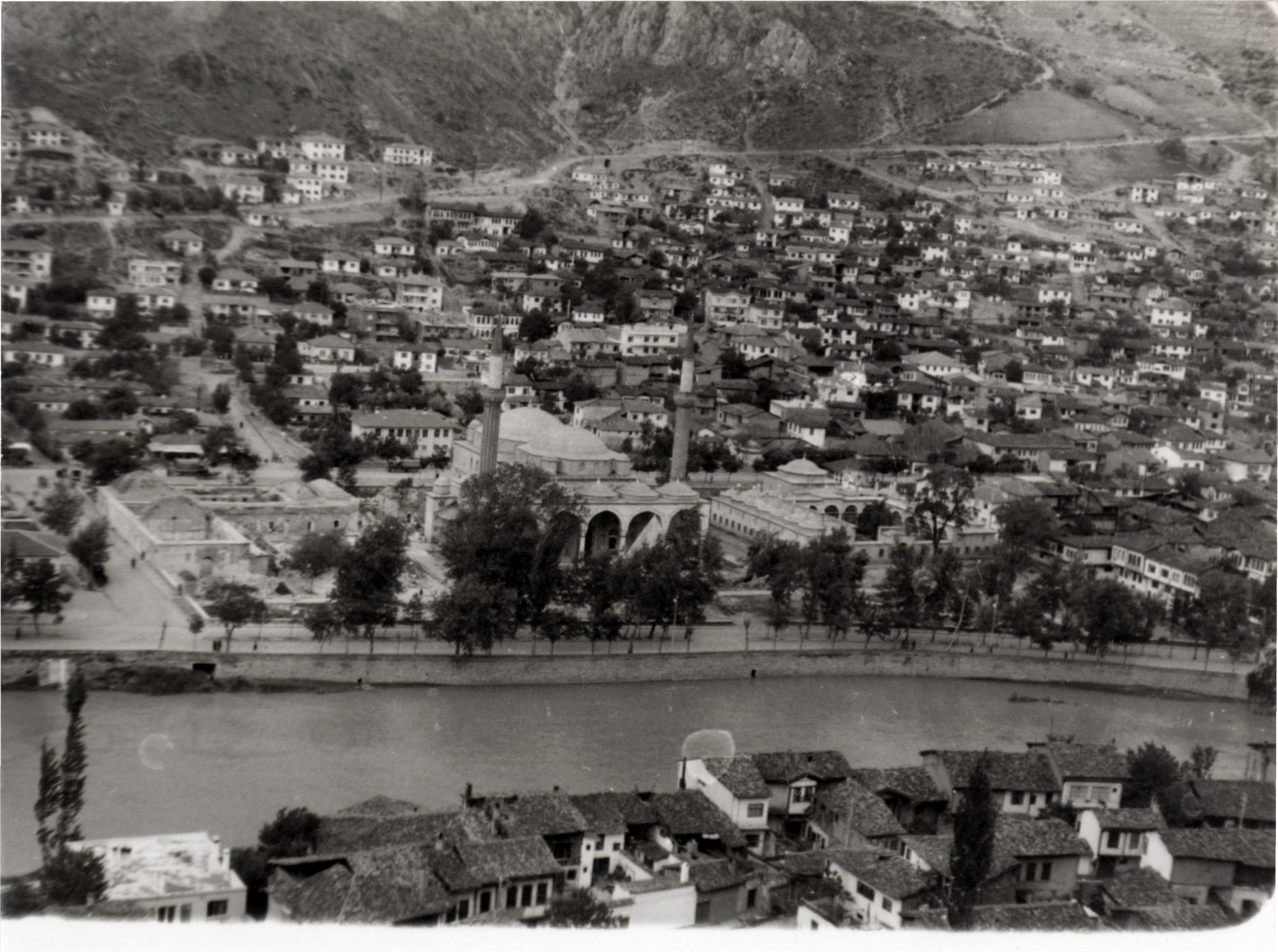
The Sultan Bayezid II Complex seen from the opposite bank of the Yeşilırmak: two minarets, domes, the late-comers' portico and the madrasa
The Sultan Bayezid II Complex, from the opposite bank of the Yeşilırmak. Hüseyin Menç archive.

The Sultan speaks

Dramatisation
Sultan Bayezid II 1447–1512 · governor of Amasya 1454–1481
SULTAN BAYEZID II

Tap the box to continue

This is a dramatisation. Every piece of information the Sultan gives rests on the sources below; the manner of speaking is invented, the information is not. The drawing was made separately, inspired by a 16th-century miniature — the miniature itself has not been animated. The voice is your device's own machine voice; it is no one's real voice.

📜 What do the documents say?

The complex was built, on Sultan Bayezid II's instructions, by his son Prince Ahmed, then governor of Amasya.1, 2 According to the mosque's own building inscription, construction began in AH 890 (1485) and was completed in the month of Rajab AH 891 (1486).3

The complex's endowment deed (vakfiye), dated AH 901 (1495–96), has survived. It lists the units as mosque, madrasa, public kitchen (imaret), school and bridge. The bridge on the list is not in Amasya: it stands at Osmancık in Çorum province, over the Kızılırmak.2 The school has not survived.2

The mosque is entered through a monumental portal beneath the five-bayed late-comers' portico; it consists of two square-plan spaces, one after the other. The madrasa to its west is made up of eighteen cells arranged in a U beside the lecture hall.4

Sources that differ. The Hijri date 901 of the endowment deed is converted as 1495 in one source and as 1496 in another.2, 5 Since the Hijri year 901 ran from late 1495 to the middle of 1496, both can be defended.

An older ground — but with caution. Citing the Cumont brothers' interpretation of a text by Gregory of Nyssa, Kuzucular says that in the Roman period a temple of the Mother Goddess stood “probably on the site of the complex or near it”.6 This is an interpretation, not established fact. On the other hand, it is recorded that the same spot was used as a musalla in the early Turkish period.6, 7

🗣️ What do the people say?

According to the story, while still a prince, Bayezid told a dream he had had to the famous calligrapher Şeyh Hamdullah. Hamdullah interpreted the dream as “the sultanate has been granted to you” and then said: “If you become sultan, do not put Amasya out of your heart.”

When Bayezid became sultan, he asked Şeyh Hamdullah, “What shall we do for Amasya?” From Saraydüzü, where they were, Şeyh Hamdullah threw his staff. The staff landed on the site of today's mosque, which was woodland at the time. He wished for the mosque to be built there.

It is said that during the building work villagers from the surrounding area, who wanted to work on it for the religious merit, quarrelled because they could not agree on how to share out the working days. The two plane trees in front of the mosque are also said to have been planted at that time as lightning rods.8

This section is a folk narrative, not a document. It is no accident that the two stand side by side: the documents record that Bayezid exempted the people of Amasya from taxes because he loved the city;3 the legend gives that love a story. Each sheds light on the other, but neither takes the other's place.

While you are there, look for

Beneath this door there is something most people never see

Even most people in Amasya don't know. Shall we tell you?

Key facts

Built
AH 890 (1485) – Rajab AH 891 (1486)3
Commissioned by
Prince Ahmed, in the name of his father Sultan Bayezid II1, 2
Endowment deed
AH 901 (1495–96)2, 5
Units in the deed
Mosque, madrasa, public kitchen, school, bridge2
Location
40.650294, 35.827037 — verified against OpenStreetMap
In the book
Kültürel Miras Boyutuyla Amasya, p. 31

📍 Open on the map

Sources

Every factual statement on this page rests on one of the sources below. Titles are given in their original Turkish so that they can be found; quotations from them are our translations.

  1. Abdizade Hüseyin Hüsameddin Yasar, Amasya Tarihi, 4 Cilt (Ankara: Amasya Belediyesi Kültür Yayınları, 1986), 114-115.
  2. Amasya Harşena Dağı ve Pontus Kral Kaya Mezarları Alan Yönetim Planı ve UNESCO Dünya Mirası Başvuru Dosyası (Amasya: Amasya Belediyesi, 2022), 80.
  3. Yunus Zeyrek, Amasya'nın Altın Tarihi (Amasya: Amasya Valiliği Yayınları, 2009), 91.
  4. Ersel Oltulu, Amasya'nın Anıtsal Eserleri ve Hızır Paşa Külliyesi Restitüsyon ve Koruma Önerisi (İstanbul: Yıldız Teknik Üniversitesi Fen Bilimleri Enstitüsü, Yüksek Lisans Tezi, 2006), 46.
  5. Elif Nur Dönmezgüç, Belgelerle Amasya Sultan II. Bayezid Külliyesi (Ankara: Ankara Üniversitesi Sosyal Bilimler Enstitüsü, Yüksek Lisans Tezi, 2023), 42.
  6. Kani Kuzucular, Amasya Kentinin Fiziksel Yapısının Tarihsel Gelişimi (İstanbul: İstanbul Teknik Üniversitesi Fen Bilimleri Enstitüsü, Doktora Tezi, 1994), 21, 60.
  7. Atlıhan Onat Karacalı, “Amasya Kentinde Yapılı Çevrenin Tarihsel Gelişimi Üzerine Bir Değerlendirme”, The Journal of Academic Social Science Studies 14/87 (Kış 2021), 178.
  8. Mustafa Güler, Amasya Efsaneleri (Amasya: Eser Ofset, 1996), 49.