Adım Adım Amasya

The Princes' Route · Stop 12

Amasya Bedesten

Its domes were dismantled, the roof built in their place collapsed, it stood open to the sky for years, and half of it was demolished. Five hundred years later it is still standing.

1483 Hüseyin Ağa, Agha of the Gate Bazaar
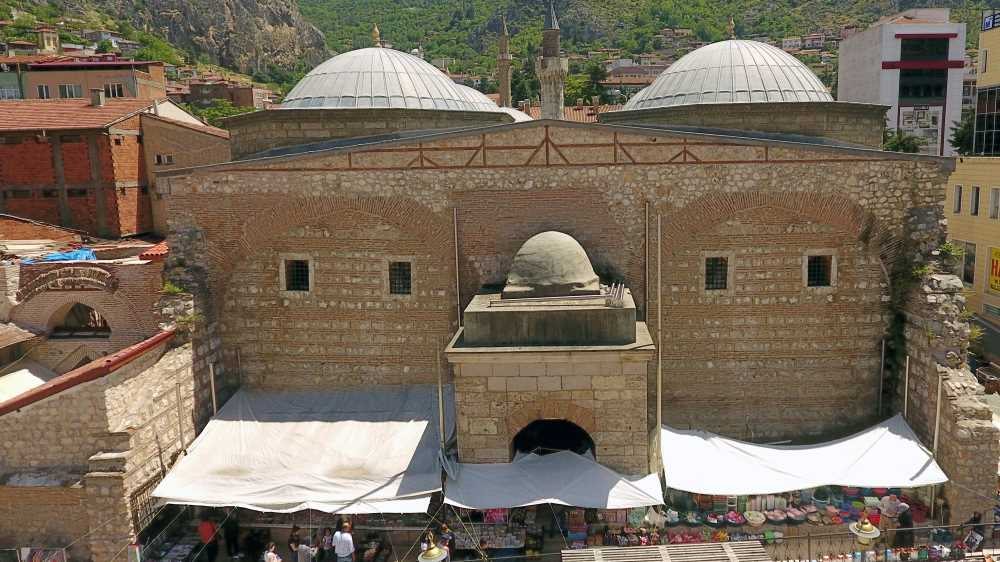
The Amasya Bedesten: two large lead-covered domes, stone outer walls with blind arches, market stalls in front
The Amasya Bedesten. Kültür Portalı (Kültürel Miras Boyutuyla Amasya, Photo 32).

The building's own inscription

“…the building was commissioned by the benevolent and God-fearing Hüseyin Ağa, son of Abdulmuin. He is known as the Kapı Ağası (Agha of the Gate). May God protect from ruin, for as long as his rule lasts, the realm and sultanate of Bayezid Han, son of Sultan Muhammed Han, ruler of the seas and the lands, sultan son of a sultan. For the sake of his many good deeds and gifts, may God Most High reward him with His forgiveness.”

AH 888 / AD 1483

Translation of the inscription; our English rendering of the Turkish translation1

📜 What do the documents say?

The bedesten was built in 1483 by Hüseyin Ağa, one of the Aghas of the Gate of Bayezid II, to provide income for his foundations.2 The same Hüseyin Ağa was also the founder of the Büyük Ağa Madrasa, another stop on this route.

The building has the plan features of the Ottoman bedestens of the Classical period and was built on sloping ground. Along its north–south axis it measures roughly 36.75 × 34.94 metres.1

Its plan has changed. The bedesten's original form was rectangular; because a large part of it was demolished in 1950, it has a square plan today.1 So the proportions you see today are not the building's own — they are the proportions the demolition left behind.

👁️ What did the witnesses see?

1645 · Evliya Çelebi. In Amasya there are masters of every trade, but the most famous are the tailors and the cotton-fluffers (hallaç: the craftsman who beats wool and cotton soft with a bow): When the fluffer takes his bow in hand and strikes with his mallet in twenty-four styles, one is lost in admiration. Evliya adds: The young barbers and the young halva-makers are very famous and true artists.3

1781 · Domenico Sestini. The Italian traveller, a collector of old coins, spends two days in Amasya and takes offence at one thing: Many jewellers in the bedesten and the hans, knowing that the Franks (Europeans) who come to Amasya buy antique coins and medallions, keep the prices of coins and medallions in very poor condition very high. The collector's complaint suggests the jewellers knew their business, too.3

1861 · Georges Perrot. Listing the endowment income of the city's madrasas, the French archaeologist also mentions their shops inside the bedesten.3 That is exactly what the bedesten had been built for: to bring income to endowments.2 Perrot's words on the madrasas are at the Büyük Ağa stop →

The travellers' words are given from the Turkish translations in Ali Tuzcu's compilation; the English is ours.

Evliya Çelebi describes the market

Dramatisation
Evliya Çelebi 1611–1682 (?) · ten volumes of the Seyahatnâme (Book of Travels) in fifty years
EVLİYA ÇELEBİ

Tap the box to continue

This is a dramatisation. Every word comes from Evliya Çelebi's Seyahatnâme, where he mentions the city's market and bedesten, in the Turkish rendering of Ali Tuzcu's compilation;3 simplified, but no information has been added. The image is an illustration made with AI (Google Gemini); on a slow connection it is replaced by a drawing made separately, inspired by 17th-century dress. The voice is your device's own machine voice; it is no one's real voice.

How much was halva in Ramadan?

A price fixed for a commodity by the authorities is called a narh. According to Amasya's court records for the years 1652-1654, on the fifteenth day of Ramadan (9 August 1653) almond halva cost 16 akçe, walnut halva 12, and makuş halva 12 akçe.4

What was makuş halva? The record gives its name and price, but no recipe. According to Ebru Keten, who studied the records, it is very likely to have been a local halva or a local sweet.4

Five hundred years in a few lines

This building's story is a story of survival.2

“The old walls, which for almost 500 years have managed to stay standing against all the odds, have come back to life.”2

While you are there, look for

Key facts

Built
AH 888 / AD 1483, according to its inscription1
Commissioned by
Hüseyin Ağa, son of Abdulmuin — Agha of the Gate1
Purpose
To provide income for his foundations2
Size
About 36.75 × 34.94 m1
Plan
Originally rectangular; square after the 1950 demolition1
Last restoration
1971, General Directorate of Foundations2
Location
40.651113, 35.831739 — verified against OpenStreetMap
In the book
Kültürel Miras Boyutuyla Amasya, p. 63

📍 Open on the map 🚶 Walking route (Google) 🚶 Walking route (Yandex)

Sources

Every factual statement on this page rests on one of the sources below. Titles are given in their original Turkish so that they can be found; quotations from them are our translations.

  1. Gülname Kübra Çelebi, Amasya'da Bulunan Ticaret Yapıları (Ordu: Ordu Üniversitesi Sosyal Bilimler Enstitüsü, Yüksek Lisans Tezi, 2023), 28. — Translation of the bedesten's inscription, its plan and dimensions.
  2. Amasya Valiliği, Amasya Şehir Rehberi (Amasya: Amasya Valiliği, 2013), 38-39.
  3. Ali Tuzcu, Seyahatnâmelerde Amasya (Amasya: Amasya Belediyesi Kültür Yayınları, 2007), 70-72, 79, 83, 226. — Evliya Çelebi on the craftsmen, markets and bedesten of Amasya (70) and on its craftsmen (71-72); Domenico Sestini's visit of 18-20 May 1781 (79) and his observation on the jewellers (83); Georges Perrot's observation on the endowments of the madrasas (226).
  4. Ebru Keten, 10 No'lu Amasya Şer'iyye Siciline Göre Amasya'nın İki Yılı: 1652-1654 Yılları Arasında Amasya'nın Sosyal ve Ekonomik Tarihi (Sivas: Sivas Cumhuriyet Üniversitesi Sosyal Bilimler Enstitüsü, Yüksek Lisans Tezi, 2021), 32, 107-108. — The definition of the narh (32); the table of halva prices for 1653 and the note on makuş halva (107-108).

Continue the route

The Princes' Route · stop 12 of 14

Yalıboyu · stop 4 of 9