Adım Adım Amasya

The Princes' Route · Stop 11

Amasya Castle

On the summit of Mount Harşena, a structure that has done the same job for five thousand years. Who built it is still debated.

From the Bronze Age to the Ottomans Mount Harşena North bank
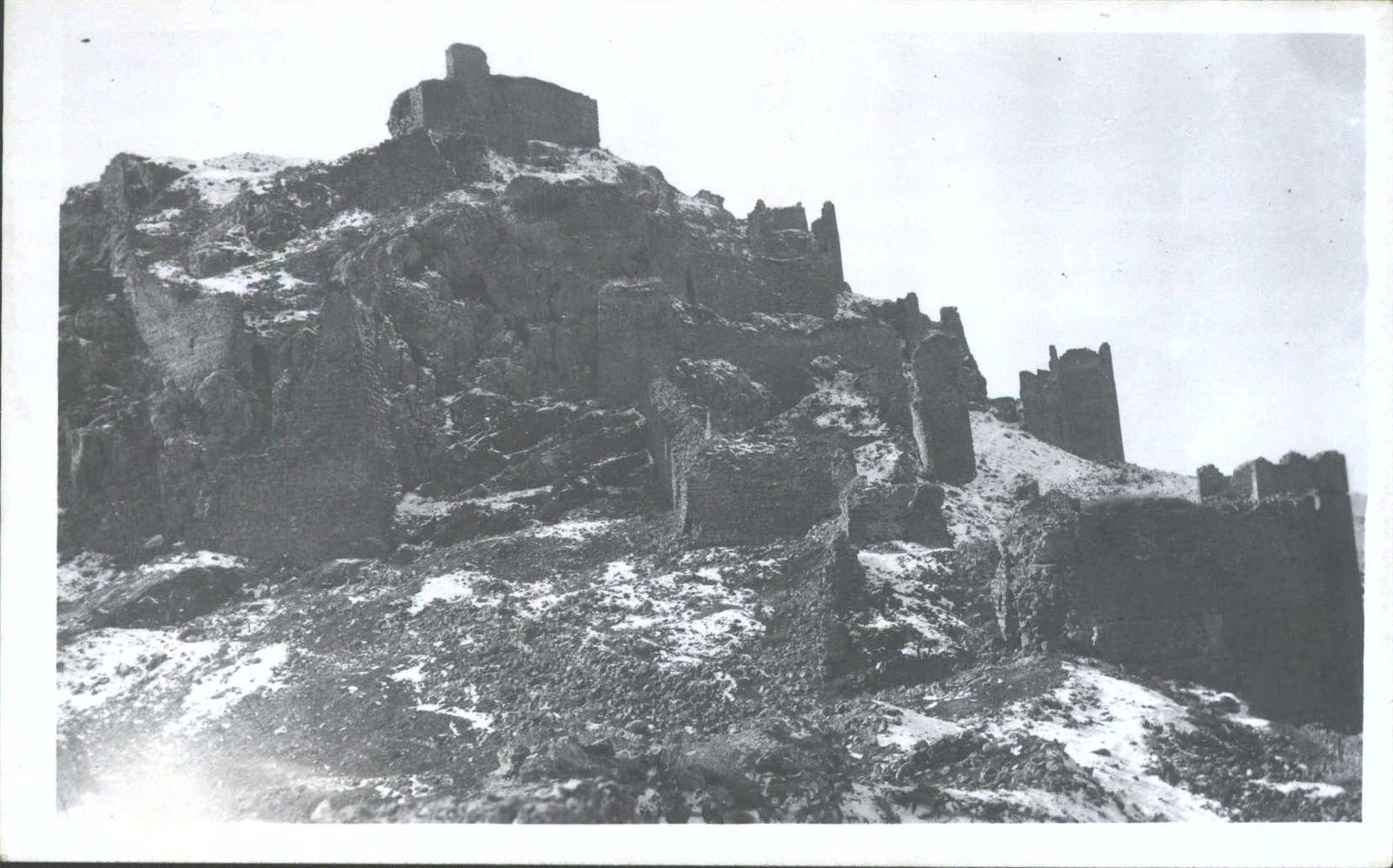
Amasya Castle under snow: ruined walls and towers running along the ridge
Amasya Castle. TTK Archive (Kültürel Miras Boyutuyla Amasya, Photo 30).
My city is situated in a large deep valley, through which flows the Iris River. Both by human foresight and by nature it is an admirably devised city, since it can at the same time afford the advantage of both a city and a fortress; for it is a high and precipitous rock, which descends abruptly to the river… These peaks are two in number, are united with one another by nature, and are magnificently towered.
Strabo (64 BC – AD 21), the geographer from Amasya — describing his own city. “Iris” is the ancient name of the Yeşilırmak.1
The English is the published translation: Strabo, Geography 12.3.39, tr. H. L. Jones (Loeb Classical Library, 1928).

📜 What do the documents say?

Because of its strategic and fortified position, the castle was used continuously for defence from the Bronze Age to the end of the Ottoman period.2 Its first construction is thought to date from around 3200 BC.3

In the sources it is called Harşena Kalesi, Yukarı Kale (the Upper Castle), Kale-i Bâlâ, Muşalem or Kal'a-i Kahkaha-yı Rum.4, 5 In terms of the area it covers, it is divided into three parts — the Hatuniye neighbourhood, the Kızlar Sarayı and the castle proper;6 architecturally it consisted of two main parts, the Enderun Kalesi (the Lower or Inner Castle) and the Harşena Kalesi (the Upper Castle).7, 8

After the defeat of Mithradates by the Romans it was pulled down by Pompey, and later repaired by the Romans.8

It was not only soldiers who lived in the castle. Within the thin walls stood mud-brick houses where the servants and the castle commander lived.7 There were also an old-style palace, the Yıldırım Han Mosque (the Andre Church, converted into a mosque after the Christians were moved out), a madrasa, a dervish lodge, a public kitchen, two bathhouses, dungeons, powder stores, wheat granaries, cisterns and water wells.9

🗣️ What do the people say?

According to the narrative, when Harşena Castle was being built, the stones were hauled on sledges with deer in harness.

The note of Mustafa Güler, who collected this narrative, is also worth recording — he too leaves the verdict to the reader:

“We make no judgement on whether this is true or false. But even if the work was done by people, would not the hauling of the stones in those days, and their being carried up there, be the stuff of legend?”10

This section is a folk narrative, not a document. Güler adds that all the castles in Anatolia are told of in this way — so this is not a narrative peculiar to Amasya.10

Who built the castle?

The sources do not agree. This page takes no side; all three views are given as they are.11, 12, 13

Arab historians The castle was built by a commander named Harşena — and the mountain takes its name from him.
Western historians The castle was built by the Pontic King Mithradates.
Evliya Çelebi This imposing structure may have belonged to the ancient people he calls the “Amelika”.

Evliya Çelebi describes the castle

Dramatisation
Evliya Çelebi 1611–1682 (?) · ten volumes of the Seyahatnâme (Book of Travels) in fifty years
EVLİYA ÇELEBİ

Tap the box to continue

This is a dramatisation. Everything he says comes from Evliya Çelebi's description of Amasya Castle in the Seyahatnâme;14 it has been simplified and put into English from its modern Turkish rendering, and no information has been added. The drawing was made separately, inspired by 17th-century dress. The voice is your device's own machine voice.

Did Evliya exaggerate again?

We have to ask, because Evliya's numbers sometimes do not add up. And on this page we show where he is right and where he is not, side by side.

Where he is wrong Evliya lists the districts (kaza) and sub-districts (nahiye) of the sancak of Amasya. This list does not match the 1642 land survey (tapu tahrir) records of the sancak of Amasya. An example: Bulak, which Evliya calls the seat of a district, is a village of three hundred people in the register.14
Where he is right He writes that the underside of the castle is full of caves — and that is true: the rock beneath the castle is still full of hollows today, the best known being the Rock Tombs of the Kings. He adds that the people took refuge in these caves during the Celali revolts.

Why do we still read him? Because Evliya does not only give measurements; he records how a city saw itself. That he calls the castle “the work of Ferhat” tells us not who built the castle, but which story the people of 17th-century Amasya attached to it — and that too is a document.

Who repaired it

The castle was never the work of a single age. Every ruler repaired it and added to it.11

💧 Cilanbolu and the diver who never came back

In the middle of Harşena Castle, on the high ground in line with the great gate, there is a well: Cilanbolu. It descends from south to north, and you go down by some hundred and fifty steps. Its mouth is wide and round; it begins as masonry and further down continues as a passage cut into the rock. Deeper down, the steps have been lost through damage.15

Vâzıh Efendi (1764–1831), the scholar who wrote the first city history of Amasya, records an incident connected with this well. The governor Mikdad Ahmet Paşa wonders where the water comes in and where it goes out, and finds a diver. The diver's condition is this:

“Sir, I will go into this well. If I come out of the water safe and sound, I have no doubt that you will pay me my fee and more. But I may not come back safe and sound. So give me my blood-money now, so that I may divide it among my heirs with my own hand, according to the law of inheritance. Only then will I dive into the water.”

They agree on 2500 kuruş. The man shares the money out among his heirs with his own hand, and then dives.

“And gone he was, for good!”

Hoping that at least his body would come up to the surface of the water or out into the river, they wait day and night for a long time. It is never seen. Vâzıh Efendi draws this conclusion from the incident: the water's outlet is wide enough for a man, but where this water goes is not known.16

This is not a legend but an incident recorded by Vâzıh Efendi. Even so, it rests on a single source.

While you are there, look for

Key facts

First built
Around 3200 BC (Bronze Age)3
Built by
Disputed — see above11, 12, 13
Other names
Harşena Kalesi, Yukarı Kale, Kale-i Bâlâ, Muşalem, Kal'a-i Kahkaha-yı Rum4, 5
Parts
Hatuniye neighbourhood · Kızlar Sarayı · the castle proper6
Location
40.655211, 35.827452 — verified against OpenStreetMap
In the book
Kültürel Miras Boyutuyla Amasya, p. 61

📍 Open on the map
Sources

Every factual statement on this page rests on one of the sources below. Titles are given in their original Turkish so that they can be found; quotations from them are our translations.

  1. Tuğrul Balaban, Amasya Efsane, Menkabe ve Memoratları (Amasya: Amasya Valiliği, 2014), 7.
  2. E. Emine Naza-Dönmez, “Amasya Harşena Kalesi ve Kızlar Sarayı Kazılarında Ele Geçen Altın Memluk Sikkeleri Üzerine Düşünceler”, Türk Tarih Kurumu, 623.
  3. Atlıhan Onat Karacalı, “Amasya Kentinde Yapılı Çevrenin Tarihsel Gelişimi Üzerine Bir Değerlendirme”, The Journal of Academic Social Science Studies 14/87 (Kış 2021), 174.
  4. Mehmet Fatih Becerik, XIX. Yüzyıl Ortalarında Amasya Şehrinin Sosyo-Ekonomik Yapısı (İstanbul: İstanbul Üniversitesi Sosyal Bilimler Enstitüsü, Doktora Tezi, 2022), 21.
  5. Şenol Susoy, Millî Mücadele Yıllarında Amasya (İstanbul: Marmara Üniversitesi Türkiyat Araştırmaları Enstitüsü, Yüksek Lisans Tezi, 2008), 1.
  6. E. Emine Naza-Dönmez, “Amasya Harşena Kalesi ve Kızlar Sarayı Kazısı 2010 Yılı Sonuçları”, 33. Kazı Sonuçları Toplantısı C. IV (Ankara, 2012), 267-282.
  7. Merve Karakulak, XVIII. Yüzyılın İkinci Yarısında Amasya'nın Gündelik Hayatı (Şer'iyye Sicillerine Göre) (Ordu: Ordu Üniversitesi Sosyal Bilimler Enstitüsü, Doktora Tezi, 2022), 36, 37.
  8. Ahmet Caner Çatal, 19. Yüzyılın İkinci Yarısında Amasya Şehri'nin Demografik Yapısı ve İskân Siyaseti (Niğde: Niğde Üniversitesi Sosyal Bilimler Enstitüsü, Yüksek Lisans Tezi, 2009), 8, 9.
  9. Önder Duman – İbrahim Serbestoğlu, Türklerde Çevre ve Şehircilik: Medeniyetimizi Yaşatan İller — Amasya, C. II (Ankara: Çevre, Şehircilik ve İklim Değişikliği Bakanlığı, 2023), 33-34.
  10. Mustafa Güler, Amasya Efsaneleri (Amasya: Eser Ofset, 1996), 34-35. — The section “Kırklar (Harşene) Dağı ve Efsanesi”: the narrative of the castle stones being hauled by deer, and Güler's own reservation.
  11. Fuat Er, XV. ve XVI. Yüzyılda Amasya (Elazığ: Sosyal Bilimler Enstitüsü, Yüksek Lisans Tezi, 2009), 32.
  12. Fatih Kertil, Büyük Selçuklu Döneminden Osmanlı Yönetimine Kadar Amasya Tarihi (Samsun: Ondokuz Mayıs Üniversitesi Sosyal Bilimler Enstitüsü, Yüksek Lisans Tezi, 2014), 13.
  13. Ali Tuzcu, Seyahatnâmelerde Amasya (Amasya: Amasya Belediyesi Kültür Yayınları, 2007), 65.
  14. Evliya Çelebi, Seyahatnâme, naklen Ali Tuzcu, Seyahatnâmelerde Amasya (Amasya: Amasya Belediyesi Kültür Yayınları, 2007), 65-67. — The description of the castle; also Tuzcu's note that Evliya's list of districts and sub-districts does not match the 1642 land survey records of the sancak of Amasya.
  15. Amasya Valiliği, Amasya Şehir Rehberi (Amasya: Amasya Valiliği, 2013), 48-49. — The section “Cilanbolu Kuyusu” (the Cilanbolu Well): “In the middle of Harşena Castle, in line with the great gate… One goes down by some hundred and fifty steps.”
  16. Mustafa Vâzıh Efendi, Amasya Fetvaları ve İlk Amasya Şehir Tarihi (El-Belâbilü'r-Râsiyye fî Riyâzi Mesâili'l-Amâsiyye) (Amasya: Amasya Belediyesi, 2014), 7-8.