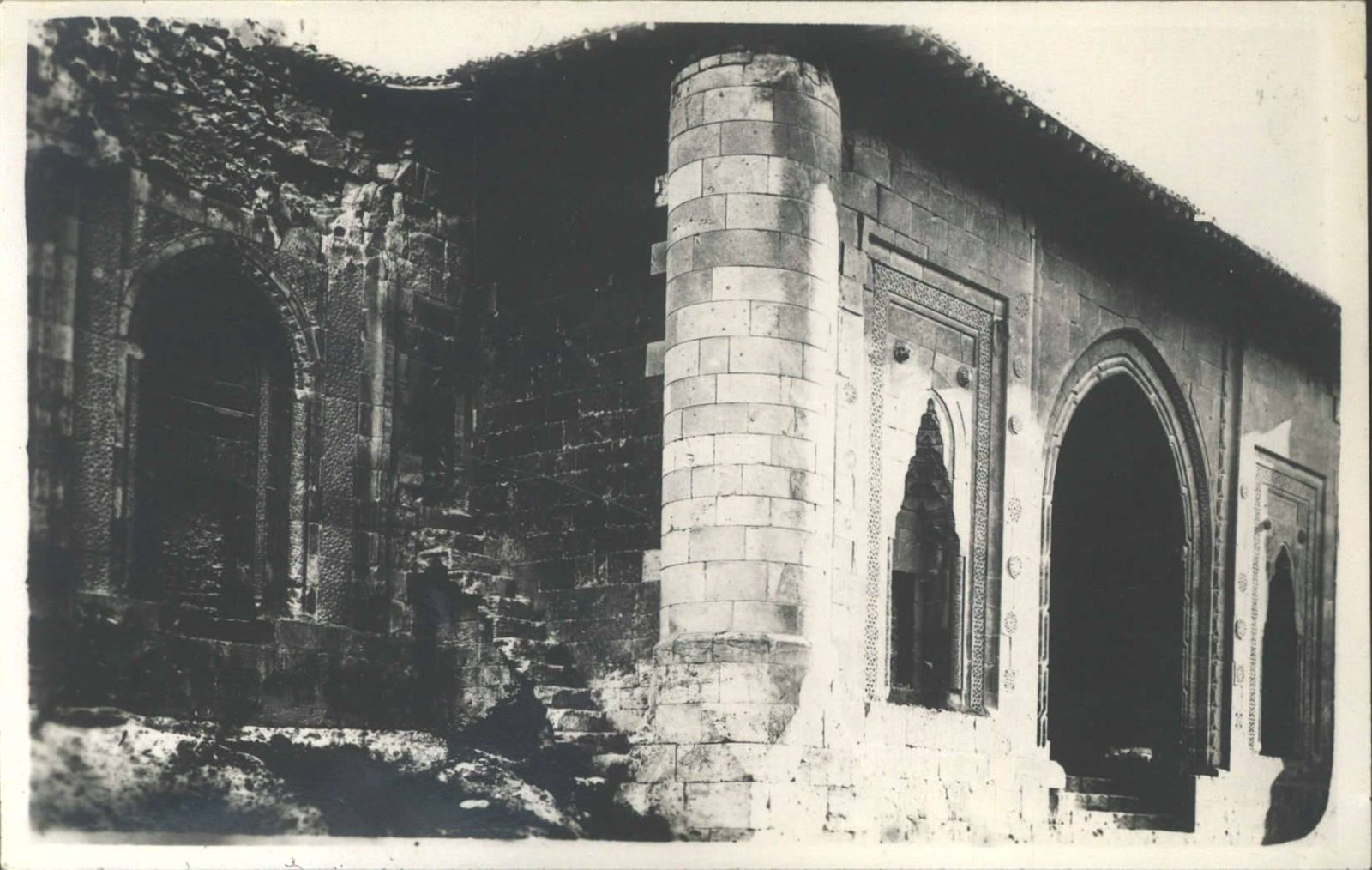
Almost all Anatolian tombs have an octagonal body and a conical cap.
This one is a cube. To see the difference, you only
need to look at the tombs nearby.
1278–1279Seyfeddin TorumtayKılıçarslan Türbesi
Side by side. On the left the tomb and its arched niche, on the right the iwan
façade of the Gökmedrese; between them a huge
cylindrical corner buttress. The tomb's roof is flat — don't look for a
conical cap.1TTK Archive (Kültürel Miras Boyutuyla Amasya, Photo 22).
📜 What do the documents say?
The building, also known among the people as the “Kılıçarslan
Tomb”, was built of dressed stone in 1278-1279 by
Seyfeddin Torumtay, governor of Amasya.1
It is rectangular in plan and of two storeys, covered inside by a barrel vault
and outside by a flat roof.2
Inside are the graves of Torumtay, his children and his
grandchildren.3
The tomb's owner speaks
Dramatisation
Seyfeddin Torumtay
Governor of Amasya · founder of the tomb
SEYFEDDİN TORUMTAY
Tap the box to continue
This is a dramatisation. Every piece of information given in Torumtay's voice
rests on the sources below; the manner of speaking is invented, the information is
not. The drawing was made separately, inspired by 13th-century Seljuk dress.
The voice is your device's own machine voice.
What does his account rest on?
His being taken into the palace, his appointment as governor of Amasya in the time
of Abaqa Khan after the Mongol invasion, and his holding that post for about
thirty years — source 4.4
His building the tomb in 1278-1279, of dressed stone —
source 1.1
The building's plan and roofing, and the lost repair inscription —
source 2.2
The graves of himself, his children and his grandchildren inside —
source 3.3
Why does it look different?
Put this tomb beside the others in Amasya, and the difference jumps out at once.
We are not the first to notice the difference. Mustafa Vâzıh Efendi, who wrote
the first city history of Amasya in the 19th century, described the building like
this:
Torumtay Paşa had a tomb resembling the Kaaba built.
Mustafa Vâzıh Efendi, as quoted in
Kültürel Miras Boyutuyla Amasya.6
The reason for the comparison is architectural: a cubic body and a flat roof.
Vâzıh Efendi is not making a claim about faith; he is describing the shape he
saw.
The inscription that is no longer there
The tomb had a repair inscription. According to Hakkı Önkal, it was inside,
above the south window, written in talik script, and it said this:
1309 / 1891Year of the repair (Hijri / AD).
Abdülhamid IIThe reign in which the repair was made.
Necip BeyThe trustee who had the repair made.
Talik scriptThe script of the inscription.
But this inscription is no longer in its place today.
The source records this plainly.2 So the four pieces of information above
come from a stone you can no longer see.
There is a rule on this page: where a building has an inscription, its date is
given as certain — because an inscription is a signature. Here there was a
signature, and it has been lost. The only thing that keeps the information
alive is the researcher who read it in place and wrote it down.
Look above the south window
If you can go inside, find the south window and look at the blank surface
above it. The repair inscription stood there.2
Then go outside and look for a roof. You won't find one — because it is
flat.2 If you want to see the opposite in Amasya, go to the
Halifet Gazi Tomb: there you will find an octagonal
body and a conical cap.5
Between the two lie fifty years and a difference of choice.
And think about this: three generations lie inside this tomb — Torumtay, his
children and his grandchildren.3 The building was made not for one person
but for a family.
While you are there, look for
The flat roof. There is no conical cap.2
The dressed-stone work.1
The two storeys. The building has two storeys, and a barrel vault
inside.2
Above the south window. Where the lost inscription was.2
The Gökmedrese next door.
The same founder, twelve years apart — by the verified coordinates the two are
32 metres apart.1, 6
The cylindrical buttress between them. That thick mass of stone standing
between the two buildings in the photograph.
Key facts
Date
1278–12791
Commissioned by
Seyfeddin Torumtay, governor of Amasya1
Popular name
Kılıçarslan Türbesi1
Material
Dressed stone1
Plan
Rectangular, two storeys; barrel vault inside, flat roof outside2
Repair
1309 / 1891 — the trustee Necip Bey;
its inscription is no longer in place2
Buried here
Torumtay, his children and his grandchildren3
Location
40.649733, 35.82006 — verified against OpenStreetMap
Every factual statement on this page rests on one of the sources below.
Titles are given in their original Turkish so that they can be found;
quotations from them are our translations.
Kani Kuzucular, Amasya Kentinin Fiziksel Yapısının Tarihsel Gelişimi (İstanbul: İstanbul Teknik Üniversitesi Fen Bilimleri Enstitüsü, Doktora Tezi, 1994), 41.
Zeynep Küpra Ketil, Amasya Türbeleri (Konya: Selçuk Üniversitesi Sosyal Bilimler Enstitüsü, Yüksek Lisans Tezi, 2019), 24-25. — Based on Hakkı Önkal's findings.
Osman Fevzi Olcay, Amasya Şehri (Amasya: Amasya Belediyesi, 2010), 47.
Kültürel Miras Boyutuyla Amasya (Amasya: Amasya Üniversitesi, BAP Projesi SEB-BAP25-0233, 2026), 19. — The section “İlhanlılar Dönemi Amasya”: Seyfeddin Torumtay's being taken into the palace in the time of Sultan Alâeddin Keykubad, his appointment as governor of Amasya in the time of Abaqa Khan after the Mongol invasion, and his holding the post for about thirty years.
Tolga Aydın, Amasya Tekkeleri (Bursa: Bursa Uludağ Üniversitesi Sosyal Bilimler Enstitüsü, Yüksek Lisans Tezi, 2019), 61.
Mustafa Vâzıh Efendi, Amasya Fetvaları ve İlk Amasya Şehir Tarihi (El-Belâbilü'r-Râsiyye fî Riyâzi Mesâili'l-Amâsiyye) (Amasya: Amasya Belediyesi, 2014), 59.
The repair inscription is not in place. The information about the 1891 repair therefore rests not on the stone but only on the literature.