Adım Adım Amasya

Ancient Traces Route · Stop 5

Sultan Mesud Tomb

There is a sultan in its name. But who lies inside it is not known — not even whether it belongs to the sultan whose name it bears.

14th century Iwan-type tomb In the museum garden
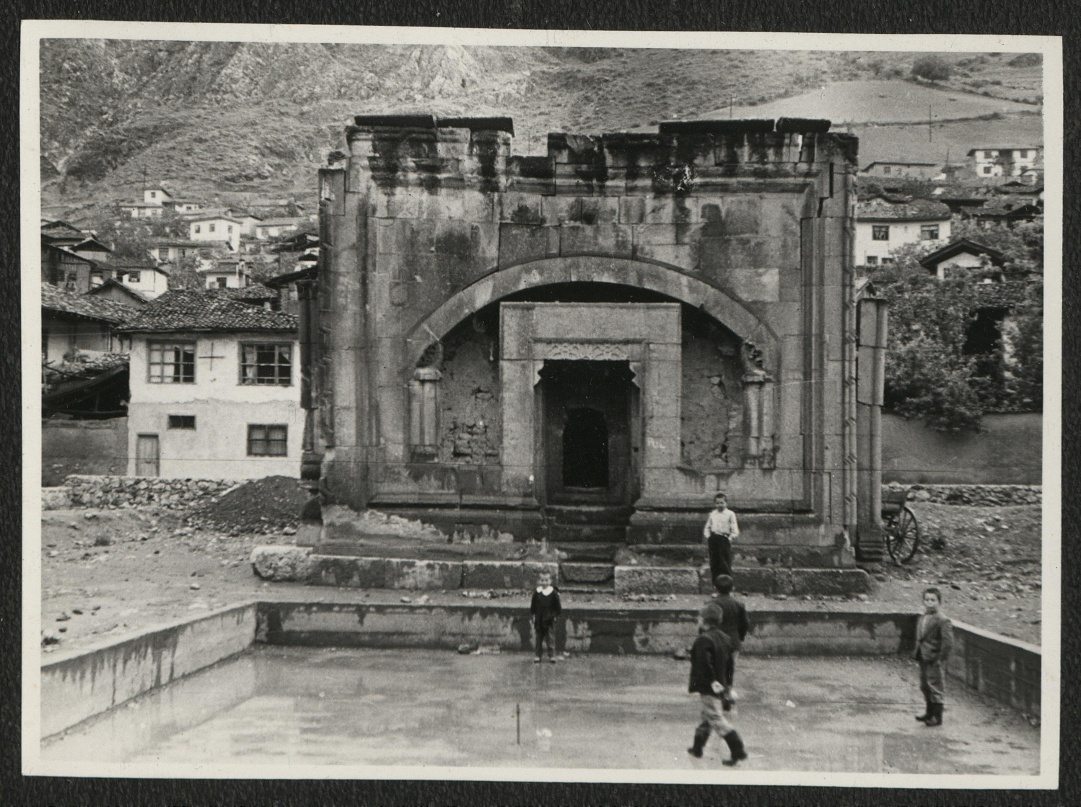
A tomb in the form of a large arched iwan; the iwan opening partly walled up, a small door in the middle; an empty pool in front and children playing
An iwan-type tomb. The opening beneath the great arch has been partly walled up, with a small door left in the middle — this is the group the source calls “tombs whose iwan opening is partly closed”.1 The children playing in front give the scale. TTK Archive (Kültürel Miras Boyutuyla Amasya, Photo 21).

📜 What do the documents say?

The tomb is in the Üçler neighbourhood in central Amasya; today it stands in the garden of the Amasya Museum.1

It is an iwan-type building, dated on the basis of its architectural plan to the 14th century (around 1385). In terms of plan it belongs to the “iwan-plan” tombs, and to the group of “tombs whose iwan opening is partly closed”.1

According to Hüseyin Hüsameddin Bey, the lower part of the tomb takes the form of a crypt, and it is understood that the Sultan is buried here.2

Who lies inside?

There is no clear information.

The source puts it like this: there is no clear information on whether the tomb belongs to Mesud I or on who is buried in it.1

So the name is a claim, not a document. The building is known as the “Sultan Mesud Tomb”; researchers have not been able to confirm it. Hüseyin Hüsameddin's observation of the crypt2 can be counted as a pointer, but it gives no certainty.

There is a small difference in the dating too

Around 1385

On the basis of its architectural plan, the building is dated to the 14th century, around 1385.1

1387

Tanju Cantay dates the building to 1387.1

The difference is two years — small. But both are estimates made from the plan; there is no inscription giving a date.

A mummy room for thirty-five years

For a long time this tomb was used as an exhibition space. Amasya's eight mummies were moved to this tomb in 1977, after the Gökmedrese, and stayed here until 2012, when they were placed in specially designed glass cases and taken into the museum building.3

There is a time lag between the sources — it is not hidden: the study on which the book relies writes that the tomb “is used today as the Mummies Museum”.2 But that study dates from 2010; the mummies were moved to the museum building in 2012.3 So that sentence was true when it was written, but it does not hold today.

Look inside the arch

This is an iwan: a vaulted space closed on three sides and open on one. But its open side is not fully open — it has been partly walled up, with a small door left in the middle.1

Follow the line of the great arch, then find where the walling begins. The difference between the two is the building's own story: a space designed to be open, closed up later.

Then look down. According to Hüseyin Hüsameddin the lower part takes the form of a crypt2 — and in his view the actual burial is there. You will not be able to see it; but you know where it is.

While you are there, look for

Key facts

Date
14th century — around 1385, or 13871
Belonging to
Unknown — whether it belongs to Mesud I is uncertain1
Plan
Iwan type; iwan opening partly closed1
Lower level
According to Hüseyin Hüsameddin, in the form of a crypt2
Neighbourhood
Üçler; today the museum garden1
Former use
Where the mummies were displayed, 1977–20123
Location
40.649312, 35.824351 — verified against OpenStreetMap
In the book
Kültürel Miras Boyutuyla Amasya

📍 Open on the map

Sources

Every factual statement on this page rests on one of the sources below. Titles are given in their original Turkish so that they can be found; quotations from them are our translations.

  1. Zeynep Küpra Ketil, Amasya Türbeleri (Konya: Selçuk Üniversitesi Sosyal Bilimler Enstitüsü, Yüksek Lisans Tezi, 2019), 30. — Tanju Cantay's dating is also quoted from here.
  2. Ülkü Duman, Anadolu Selçukluları Devrinde Amasya Şehri (Niğde: Niğde Üniversitesi Sosyal Bilimler Enstitüsü, Yüksek Lisans Tezi, 2010), 45.
  3. Öznur Akgül, Tarihi Varlıkların Sürdürülebilir Turizm Açısından İncelenmesi: Amasya Şehri Örneği (Samsun: Ondokuz Mayıs Üniversitesi Sosyal Bilimler Enstitüsü, Yüksek Lisans Tezi, 2020), 65-68.
Whom the tomb belongs to is uncertain. The sources do not agree on a name; that is why the page makes no claim.