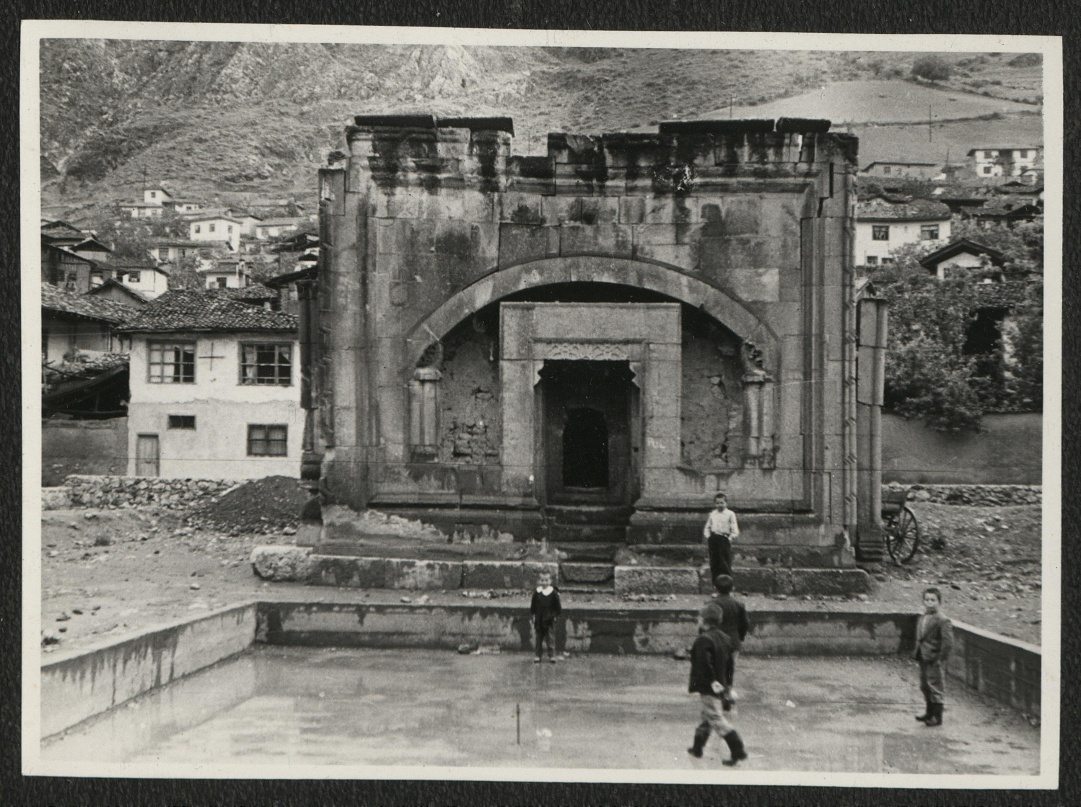
The doors, windows and residents of the buildings you
have visited on this route are here. The museum itself counts as an exhibit too:
it has moved three times.
Since 1925Archaeological museum8 mummies
This is not the museum building — it is the
Sultan Mesud Tombin the museum's garden.1
The mummies stood inside this very building from 1977 to 2012.1TTK Archive (Kültürel Miras Boyutuyla Amasya, Photo 21).
No photograph of today's museum building was found in the archive.
📜 What do the documents say?
The museum's official name is the Amasya Archaeological Museum. Its
collection displays works from the Chalcolithic Age onwards: the Bronze Age,
and the Hittite, Phrygian, Urartian, Scythian, Persian, Hellenistic, Roman,
Byzantine, Seljuk and Ottoman periods.1
The museum moved into its present modern building in 1977 and opened to
visitors in 1980.1
It is one of the most visited museums in Amasya.
The source gives the reason too: the large number of works to see — and
above all the mummies, which arouse visitors' curiosity.1
The museum moved three times
What is interesting is this: the Amasya museum was at first inside the buildings on
this route.
1925
The madrasa section of the Bayezid II Complex
begins to be used as a museum store. The madrasa's large room is
given over to a library, and three rooms to archaeological finds
and the mummies.1
1962
As the finds multiply and new display space is needed, the collection
moves to the Gökmedrese.1
1977
The museum moves to its present modern building.1
1980
It opens to visitors.1
So between 1962 and 1977, anyone visiting the Gökmedrese was really visiting the
museum. Today, by contrast, the Gökmedrese's mosque door is on display on
the second floor of the museum.1 The building and its contents have swapped
places.
This list is taken from the source as it stands.1
Museum layouts change over time; you may find it different when you go.
Eight mummies
In the mummies hall on the second floor there are eight Muslim mummies.1
İşbuğa Nuyin, Emir of Amasya
Prince Cumudar, Overseer (Nazır) of Anatolia
İzzeddin Mehmet Pervane Bey, his wife and children
The mummies have a journey of their own. In 1855, two mummies found in
the crypt of the Fethiye Mosquewere taken out and
brought to join the others in the Cumudar Tomb.1
The Cumudar Tomb adjoins the Burmalı Minare Mosque, and in
fact takes its name from the mummy of Prince Cumudar having been kept
there.2
1855
Two mummies are taken out of the crypt of the
Fethiye Mosque and moved to the Cumudar
Tomb.1
1925
The mummies are moved to the madrasa of the Bayezid II
Complex, which has been turned into a museum.1
Because they had been harmed by being brought out of dim surroundings into
daylight and by the moves, conservators from the Istanbul Archaeology
Directorate work on them; the dust and mud on them are cleaned
off.1
2002
In a joint project of the Ministry of Culture and the National Geographic
channel, the mummies are X-rayed, autopsies are carried out and
samples are taken for DNA.3
2012
Placed in specially designed glass cases, they are brought to the museum
and put on display.1
The result of the 2002 study: in the children, traces were found of
respiratory and lung diseases such as pneumonia and of a fatal disease that
stops bone growth.3
These mummies are not curiosities on show but people.
Who they were, their families, and which diseases left their traces on the children
are known. This page presents them in that spirit.
How many people come?
Extreme values from the records for 2009-2018:1
Visitors
Year
People
Domestic — highest
2017
112,766
Domestic — lowest
2009
55,176
Foreign — highest
2011
4,857
Foreign — lowest
2018
1,101
These are the extreme values of a series of records ending in 2018; they are not
today's figures.1
Close the route here
There is a reason we put the museum at the end of the route: pieces of the
buildings you have visited are here. On the second floor, look for
the mosque door of the Gökmedrese,
the window shutters of the Bayezid II Mosque
and the door of the Mehmet Paşa Mosque.1
Then go out into the garden. The
Sultan Mesud Tomb is there — where the mummies stood
from 1977 to 2012.1
So the museum's most famous exhibits spent thirty-five years inside another
monument in the museum's own garden.
And last of all: look at the doors. The doors of the mosques you have seen on
this route are no longer in their places. Bringing them here was a decision to
protect them — but it also took something away from the buildings. The museum is
this dilemma itself.
While you are there, look for
The statue of the storm god Teshub. On the first floor.1
The grave types. On the same floor; after you have seen the
Kralkaya Tombs, they take on a new meaning.1
The mosque doors and window shutters on the second floor.1
The mummies hall. Eight people; who they were is known.1
The stone works in the garden. Seven different periods side by
side.1
Every factual statement on this page rests on one of the sources below.
Titles are given in their original Turkish so that they can be found;
quotations from them are our translations.
Öznur Akgül, Tarihi Varlıkların Sürdürülebilir Turizm Açısından İncelenmesi: Amasya Şehri Örneği (Samsun: Ondokuz Mayıs Üniversitesi Sosyal Bilimler Enstitüsü, Yüksek Lisans Tezi, 2020), 65-68. — For the dates of the museum's moves, Akgül relies on the Amasya Governorship's Amasya Şehir Rehberi of 2011 (89).
Kültürel Miras Boyutuyla Amasya (Amasya: Amasya Üniversitesi, BAP Projesi SEB-BAP25-0233, 2026), 19. — The section “İlhanlılar Dönemi Amasya”; the origin of the Cumudar Tomb's name.
Hüseyin Menç, Tarih İçinde Amasya (Amasya: Amasya Belediyesi, 2014), 82, naklen Öznur Akgül, Tarihi Varlıkların Sürdürülebilir Turizm Açısından İncelenmesi: Amasya Şehri Örneği, 67. — The 2002 study and its findings.
This stop has no section in the book.Kültürel Miras Boyutuyla Amasya has no section devoted to the Amasya Museum;
this page was written entirely from the other sources above.
For opening hours, the current layout of the exhibits and visitor numbers, see
the museum's own announcements.