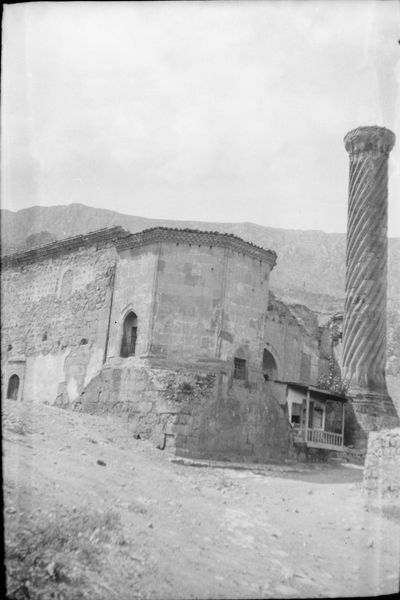
Its name comes from its minaret — but that minaret is
not the first one. The first was of wood; an earthquake and two fires took it
away.
1237–1247Necmettin Ferruh BeyNext to the Cumudar Tomb
Look at the minaret on the right: its grooves are not straight;
they wind round it. That is where the name comes from.1 The
octagonal body in the middle is the Cumudar Tomb.2 In this
picture the mosque is in ruins — according to the sources it had long been
abandoned.3Old Amasya archive.
📜 What do the documents say?
It was built between 1237-1247, in the reign of Sultan Gıyasettin
Keyhüsrev II, by Necmettin Ferruh Bey.4It is one of the
important works to have survived from the Seljuks.1
The mosque stands out for its simple structure. What is really showy is
its minaret — and that minaret was built later.
What does “Burmalı” mean?
Grooves winding round the shaft.
The flutes on the minaret's stone shaft do not run straight up;
they twist like a corkscrew. That is where the name comes from
(burmalı means twisted).5
But this minaret is not the mosque's first. The building's first
minaret, which was of wood, was damaged in the 1590 earthquake and the
1602 fire, and completely destroyed in the great fire of 1730. In its
place, in keeping with the stone building, the twisted, fluted stone
minaret formed by grooves winding round it was built.5
So the mosque's name comes from a part built some five hundred years after the
mosque itself. Had the wooden minaret not burned, this mosque might be known by
another name.
Eight hundred years
1237–47
Necmettin Ferruh Bey has the mosque built.4
1590
Earthquake. The wooden minaret is damaged.5
1602
Fire. The wooden minaret is damaged again.5
1730
The great fire. The wooden minaret is completely destroyed; in its
place the twisted stone minaret is built.5
1930s
Long abandoned and in ruins, the mosque is used as a storehouse for the
farm implements of the Ziraat Bankası (the Agricultural Bank).3
1962
It is thoroughly repaired, its minaret completed, and, restored, it
reopens for worship.3
1974
Its domes are clad in copper.3
One earthquake, two fires, a period of abandonment and a spell as a
storehouse. The building has managed to survive, but every layer on it carries
the mark of a disaster.
The tomb next door and the mummy inside
Because it adjoins the mosque, the Cumudar Tomb is also known as the
“Tomb of the Burmalı Minare Mosque”. It is octagonal, on a
square base; it is covered by a dome inside and a conical roof outside.2
The kümbet originally belonged to Ferruh Bey and his son. But it does not take
its present name from them: it is called this because the mummy of Prince
Cumudar was kept here in the Ilkhanid period.2
That mummy is no longer here. Prince Cumudar is today one of the eight
mummies in the mummy hall of the Amasya Museum.6
The tomb still takes its name from someone who is no longer in it.
Follow the grooves with your finger
Go to the foot of the minaret and pick one groove. Follow it upwards with
your eyes: it does not go straight up, it winds round the shaft. That is the
whole point; the mosque's name comes from this movement.5
Then look at the stone. This minaret was built after 1730; the body of
the mosque dates from 1237-1247.4, 5
Can the five hundred years between them be read in the colour and workmanship of
the stone?
Last, walk round to the north-east corner: there, adjoining the mosque, is
an octagonal tomb.2 A prince's mummy once lay inside.
While you are there, look for
The minaret's winding grooves.5
The copper-clad domes. Clad in 1974.3
The Cumudar Tomb at the north-east corner. Square base, octagonal body,
conical roof.2
The plain body of the mosque. The display is all in the minaret.
Across the way, the Taşhan. The mosque stands behind the Coppersmiths'
Bazaar, opposite the Taşhan.2
Key facts
Date
1237–12474
Commissioned by
Necmettin Ferruh Bey, in the reign of Gıyasettin Keyhüsrev II4
Present minaret
After the 1730 fire; twisted, fluted stone5
First minaret
Wooden; damaged in the 1590 earthquake and the 1602 fire, destroyed in the 1730 fire5
Repairs
1962 — reopened for worship; 1974 — domes clad in copper3
Adjoining tomb
The Cumudar Tomb; originally belonged to Ferruh Bey and his son2
Location
40.65009, 35.83245 — verified against OpenStreetMap
Every factual statement on this page rests on one of the sources below.
Titles are given in their original Turkish so that they can be found;
quotations from them are our translations.
Ali Yardım, Amasya Burmalı Minare Camii Kitabeleri (Ankara: Amasya Valiliği Kültür Yayınları, 2004), 1.
Zeynep Küpra Ketil, Amasya Türbeleri (Konya: Selçuk Üniversitesi Sosyal Bilimler Enstitüsü, Yüksek Lisans Tezi, 2019), 15-16.
“Burmalı Minare Camii ve Türbesi”, TDV İslâm Ansiklopedisi (Erişim 25 Haziran 2026).
Edip Uzundal, Sultan II. Abdülhamid Dönemi'nde Amasya Sancağı (Sosyal, Ekonomik, İdarî ve Demografik Yapı) (Tokat: Gaziosmanpaşa Üniversitesi Sosyal Bilimler Enstitüsü, Doktora Tezi, 2017), 166.
Ülkü Duman, Anadolu Selçukluları Devrinde Amasya Şehri (Niğde: Niğde Üniversitesi Sosyal Bilimler Enstitüsü, Yüksek Lisans Tezi, 2010), 37.
Öznur Akgül, Tarihi Varlıkların Sürdürülebilir Turizm Açısından İncelenmesi: Amasya Şehri Örneği (Samsun: Ondokuz Mayıs Üniversitesi Sosyal Bilimler Enstitüsü, Yüksek Lisans Tezi, 2020), 67.