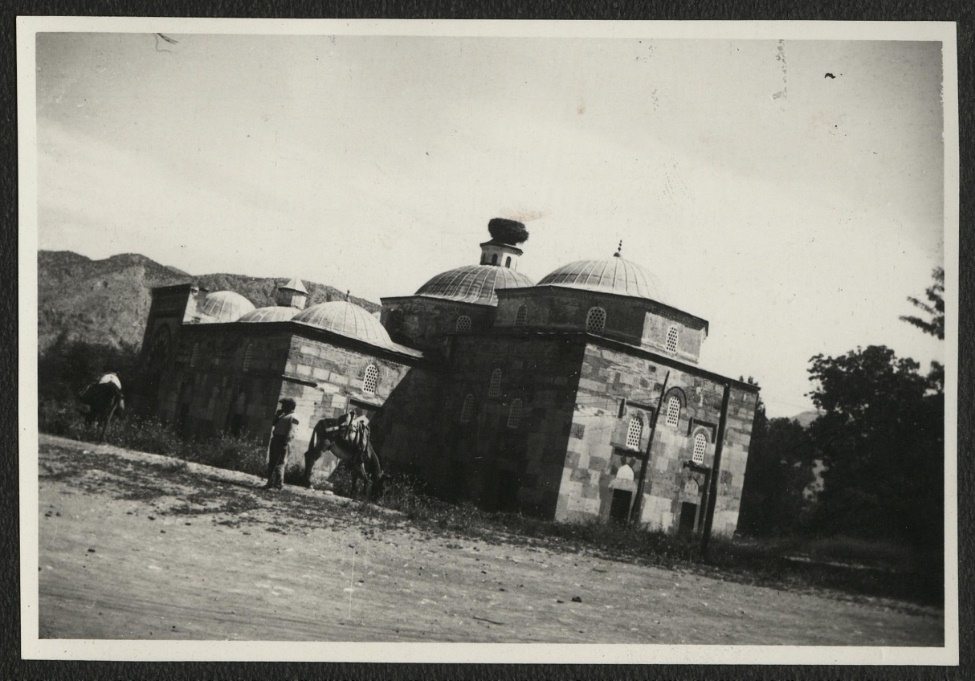
Two architects for one mosque
Osman Fevzi Olcay reads two separate inscriptions in the mosque. Both describe
the building, but they give a different architect and a different
year. This page shows both; it does not prefer one to the other.4
Door inscription
Architect Şemseddin
AH 817 · Muharram (March 1414)
The inscription says the building was erected by the vizier Bayezid Paşa in the
reign of Sultan Mehmet bin Bayezid Han.4
Column inscription in the late-comers' portico
Architect Yakup ibni Abdullah
AH 822 (1418)
There is another two-line inscription on top of the right-hand column. On the
left-hand column appears the name of the man who wrote the lettering:
Zeyneddin bin Zekeriya.4
Why might there be two dates? We do not know, and we are not guessing.
Both are written in the source; the four years between them might point to an
addition, a repair or the completion of the work. This page does not fill that
gap.
An endowment deed written not on paper, but on rock
The most surprising thing about this mosque is not the mosque itself.
Bayezid Paşa did not only have a mosque built; he also founded a waqf, a
pious foundation. Besides many movable goods, this foundation included a large
estate stretching from Merzifon to Terziköy.2
Endowment deeds are usually written on paper and kept in a chest. This one,
however, was carved onto the solid rock in the city centre, at the place called
Leğenkaya. In Ali Yardım's words it is the only one of its kind: no other
place is known in Anatolia where an endowment deed was carved directly into
rock.2
The book describes where the inscription is today: when you cross the bridge and
turn left, about fifty metres further on, at the foot of the mountain on the
right. An artificial waterfall flows over it, and the inscription now has a
glass cover.1
Reading it took more than six months
Time and weather had eaten into the stone and made the inscription
illegible. Prof. Dr. Ali Yardım deciphered it letter by letter using
squeezes (estampage) — pressing wet paper or cloth onto the stone
to take an impression of the relief.2
From the squeeze he carried away in his bag on his first visit he could read
only about fifty words; they were scattered and did not add up to a text.
Believing that thirty more words could be read, on 13 September 2000 he made
another four-day journey from İzmir to Amasya with his team. This time he took
squeezes of the worn parts of the inscription word by word, line by line,
repeating some of them two or three times. The second visit gained 25 more
words, and the number of words deciphered reached 75-80. Only then did
the meaning of the text emerge.2
A detail that shows what kind of labour this was: in an interview, Yardım said
that he had seen some of the words and letters in his dreams.
Reported by the Amasya Governorship, in the book's foreword (Sunuş).2
1The only known example: an endowment deed carved in rock2
6 months+To decipher the inscription2
75–80Words finally readable2
Key facts
- Built
- 14141 — according to the inscription, Muharram AH 8174
- Commissioned by
- Bayezid Paşa — vizier and Beylerbeyi of Rumelia1
- Architect
- Two names appear in the source: Şemseddin and Yakup ibni Abdullah4
- Calligrapher
- Zeyneddin bin Zekeriya4
- Roofing
- Two domes1
- Site
- East of the Kunç (Kuş) Bridge, on the bank of the Yeşilırmak1, 4
- Endowment deed
- At Leğenkaya, on solid rock2
- Location
- 40.657989, 35.836891 — verified against OpenStreetMap
- In the book
- Kültürel Miras Boyutuyla Amasya, p. 32
📍 Open on the map