Adım Adım Amasya

Water and Healing Route · Stop 8

Kunç Bridge

Seljuk dressed stone, three great piers. And the very spot where Amasya's best-known story takes place.

Seljuk period Dressed stone Şamlar neighbourhood
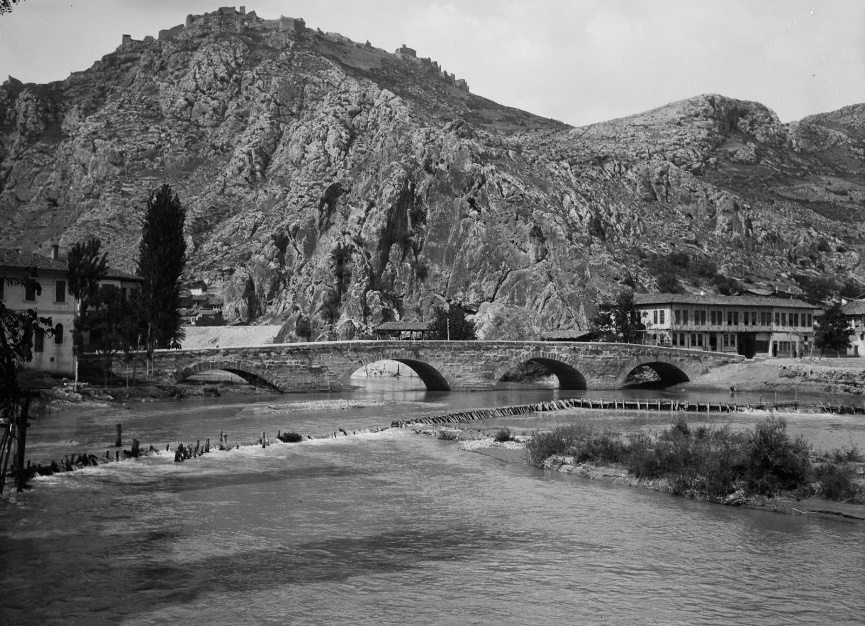
Kunç (Kuş) Bridge
Kunç Bridge. Hüseyin Menç Archive (Kültürel Miras Boyutuyla Amasya, Photo 27).

📜 What do the documents say?

Linking the Bayezid Paşa and Şamlar neighbourhoods, the bridge stands in front of the Şamlılar neighbourhood, opposite the Kumacık Bathhouse.

It bears the typical features of Seljuk architecture and is built entirely of dressed stone. Architecturally, it stands out for its wide arched spans resting on three great piers. Locally it is also known as the “Kuş Köprü” (the Bird Bridge).1

It was repaired in 1938, and its deck was paved with stone setts.1 So the surface you walk on today is not the bridge's original one.

🗣️ What do the people say?

According to the story, Lokman Hekim — Lokman the Physician — had found a cure for death. Through knowledge he received from Şahmeran, the eye of his heart had been opened: wherever he went, flowers would speak and tell him which ailment each of them could cure. In the end he found the remedy for death itself.

“When he found the cure for death, Gabriel, peace be upon him, comes. ‘O Lokman!’ he says, ‘let me look at what you’re holding.’ ‘No, I won’t let you look,’ he says, ‘I’ve found the cure for death,’ he says. ‘You found it’ — ‘you didn’t’ — and the two of them come to grips. They were on the bridge, so it is said.

Can Lokman Hekim stand up to Gabriel, peace be upon him? The moment he strikes, more than half of what he is holding spills out. Only a single sheet of paper is left.

Gabriel, peace be upon him, goes before God Almighty. ‘Don’t touch Lokman,’ he says. ‘He is a very great saint, a blessed one,’ he says.”

Read the original Turkish, as it was told

“Ölüme çare bulunca Cebrail aleyhisselam geliyo. ‘Ya Lokman!' diyo, ‘Elindekilere bakayım.' ‘Yok, baktırmam.' diyor, ‘ölüme çare buldum.' diyor. Bulduydun, bulamadıydın diye bunlar kapışıyorlar. Köprüdeymişler.

Lokman Hekim Cebrail aleyhisselamla çıkışabilir mi? Nasıl vurunca elindekilerin yarısından fazlası dökülüyo. Sadece bir kâğıt kalıyo.

Cebrail aleyhisselam Cenab-ı Allahü Teâlâ'nın yanına gidiyor. ‘Lokman'a ellemeyin' diyor. ‘O çok büyük bir evliya, mübarek.' diyor.”

From Tuğrul Balaban's collection, as it was told (the first variant); English translation ours. Informant: Hamdi Keklikçi (b. 1946), Amasya; he heard it from his elders.2
This section is a folk narrative, not a document. The collection records two variants; in both, the encounter takes place on the Künç Bridge and the secret of immortality falls into the Yeşilırmak.2

Look at the bridge's piers

The second variant of the story (informant Varol Bulut, b. 1990, Amasya city centre) ends like this:

“It is still there —on the piers of the Künç bridge and in the grass along its edge, in the heaps of earth— there is grass that grows green summer and winter.”2 “Hala orada —Künç köprünün hem ayaklarında hem de kenarındaki otlarda, toprak birikintilerinde— yaz kış yeşil biten otlar vardır.”

Now lean over and look. Is the grass there? What season is it? The story is showing you something — whether you look is up to you.

Who had the bridge built?

The sources give different accounts. This page does not take sides.1, 3

Hüseyin Hüsameddin

The bridge was commissioned by Hundi Hatun, daughter of the Seljuk Sultan Mesud II. Over time its name, too, developed from hers.3

Another view

The bridge was either repaired by Yörgüç Paşa or built by Bayezid Paşa using stones from the Ayvasıl Monastery.3

According to Hüseyin Hüsameddin, the name changed like this:1, 3

Hundi→ Kundi→ Kunç

While you are there, look for

Key facts

Period
Seljuk
Commissioned by
Disputed — see above1, 3
Other name
Kuş Köprü (the Bird Bridge)1
Structure
Entirely dressed stone; three great piers, wide arched spans1
Repair
1938 — deck paved with stone setts1
Location
40.657934, 35.835408 — verified against OpenStreetMap
In the book
Kültürel Miras Boyutuyla Amasya, p. 59

📍 Open on the map

Sources

Every factual statement on this page rests on one of the sources below. Titles are given in their original Turkish so that they can be found; quotations from them are our translations.

  1. Fuat Er, XV. ve XVI. Yüzyılda Amasya (Elazığ: Sosyal Bilimler Enstitüsü, Yüksek Lisans Tezi, 2009), 39-40.
  2. Tuğrul Balaban, Amasya Efsane, Menkabe ve Memoratları (Amasya: Amasya Valiliği, 2014), 93-94, 555-557, 724, 728. — “Lokman Hekim (I)” (informant Hamdi Keklikçi, b. 1946) and “Lokman Hekim (II)” (informant Varol Bulut, b. 1990, Amasya-Merkez); that these years are years of birth comes from the “Kaynak Kişiler” (informants) list at the end of the book. According to the motif summary on pages 93-94, in both variants the secret of immortality falls into the Yeşilırmak.
  3. Abdizade Hüseyin Hüsameddin Yasar, Amasya Tarihi, 4 Cilt (Ankara: Amasya Belediyesi Kültür Yayınları, 1986), 104.