📜 What do the documents say?
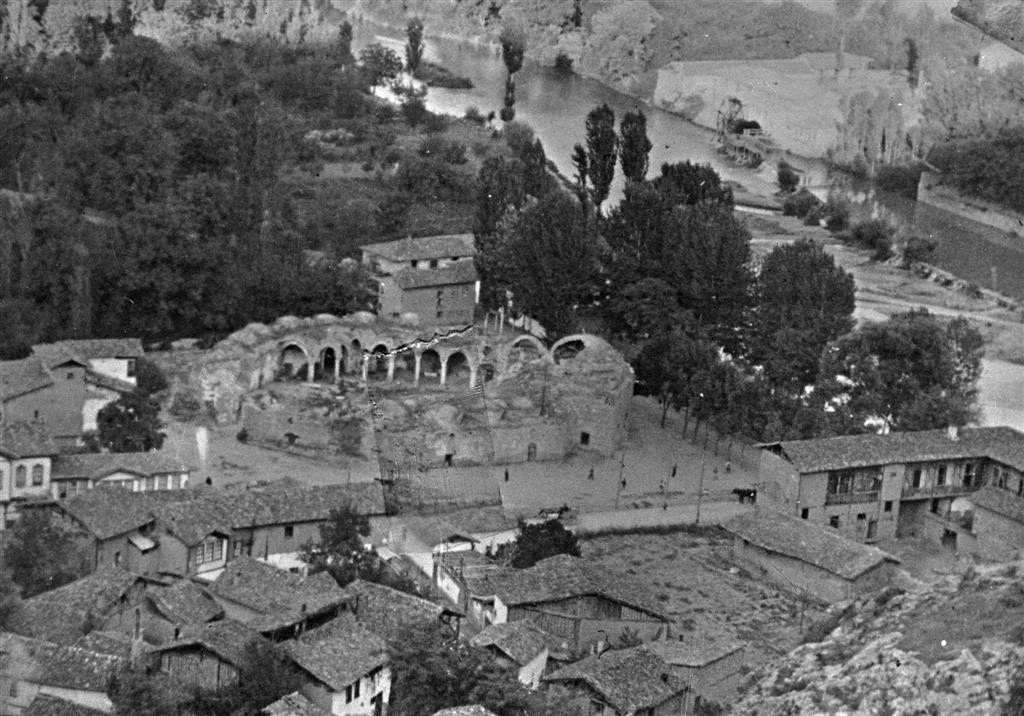
It was built in the Şamlar neighbourhood between 1485–1489 by Hüseyin Ağa,
the Agha of the Gate (Kapı Ağası) in the reign of Sultan Bayezid II.
In the sources it also appears under the names “Medrese-i Hüseyniye” and
“Baş Ağa”.3
Besides being a place of learning, the madrasa was planned as the centre of a
waqf system. Hüseyin Ağa did not only build this madrasa; he also founded
a mosque and another madrasa at Sonisa, and set up an extensive foundation
to meet the costs of these three works.4
It belongs to the group of the Altmışlı Medreseler (literally “the
sixties”, a rank of madrasa) — that is, the place where teaching of the
highest grade was given in the Amasya of its day. The best known of the
scholars who taught here is Taşköprülüzade Mustafa Müslihiddin
Efendi.1
Afterwards. Having lost its former liveliness by the late 19th century, the
madrasa remained in ruins until the 1970s after a series of earthquakes,
and was restored in 1978, taking on its present form.1
🗣️ What do the people say?
There is a story attached not to the madrasa itself but to a student who was
trained there. His real name was Abdül Baki; a Crimean Turk by origin,
he came to Amasya and worked as a molla in the Büyük Ağa Madrasa.5
Again and again he sets out to become the disciple of a sheikh in the village of
Ziyere, but each time, out of bashfulness, he cannot bring himself to reach
the sheikh, and goes back to the madrasa. In the end the sheikh comes to know of
it and sends his disciples to fetch him.
One day the sheikh gathers all his disciples and says:
“You will each bring me a bunch of flowers. Look, these mountains
are full of flowers. But no one must see the flower you pick. That is my
condition.”
The students scatter, gather flowers from under the bushes and lay their bunches
before the sheikh's lectern. Everyone is happy. The only one who is not is Abdül
Baki — he comes into the sheikh's presence weeping, empty-handed.
The sheikh asks: “O Abdül Baki, did you not gather any flowers? Where are your
flowers?”
“My master, the flowers were all invoking the name of God; I could
not bring myself to pick them. And then, did you not tell us to pick them where
no one would see? I bent down to pick a flower and
saw that God was watching me. That is why I did not pick any, sir.”
The sheikh sees that one of his students has understood what he wanted, and turns
to the others: “There — I love your friend Abdül Baki more than all of you. What
do you know of the flower's thought, and of its prayer?”
Later, in one of his talks, the sheikh says: “This student of mine is very
bashful (hicabi).” Those who hear it begin to call him “Hicabi
Efendi” — hicab means modesty and reserve. Today the name of the town of
Ziyaret, too, comes from its being the place where he is visited
(ziyaret: a visit to a shrine).5
This section is a folk narrative, not a document.