It may be the oldest bathhouse on this route — and
it is still working.
It has four different names and its date of construction is unknown, but its name
appears in an endowment deed of 1409.
Before 1409Hatuniye ComplexStill a bathhouse today
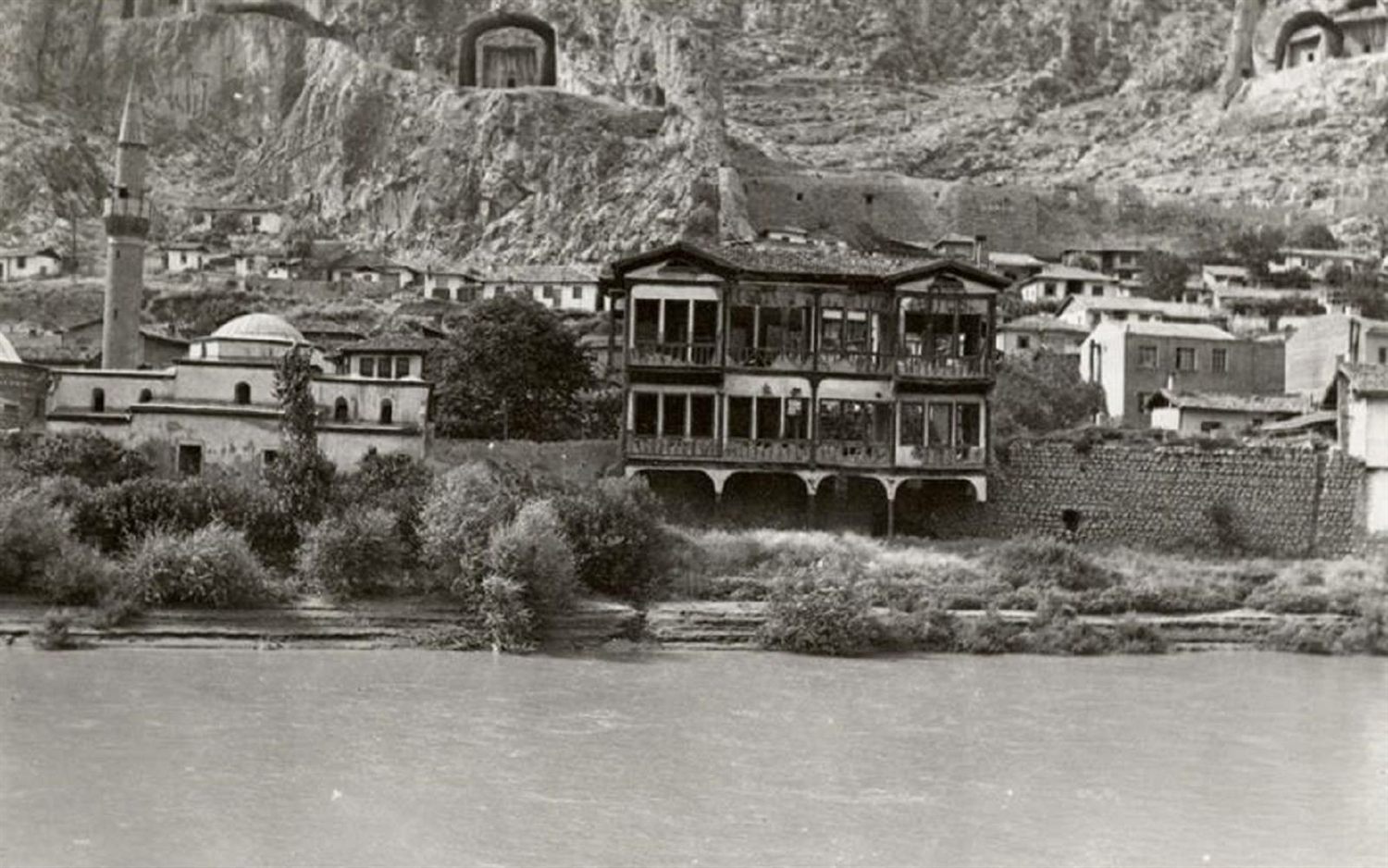
The Hatuniye waterfront. On the left the minaret and, within the
courtyard wall, domed buildings; on the right the Hazeranlar Mansion;
above, the tombs of the kings carved into the rock. The Yıldız Bathhouse is
part of this complex.1Hüseyin Menç Archive.
Because no source confirms which dome in the picture belongs to the bathhouse, it
is not marked here.
📜 What do the documents say?
The bathhouse is part of the Hatuniye Complex — the complex consists of
the Hatuniye Mosque, the primary school (sıbyan mektebi) and this
bathhouse.1
Its original date of construction is not known for certain. But a document
shows by when, at the latest, it existed: the bathhouse's name appears in the
Yakut Paşa endowment deed — which proves that the bathhouse already existed
before the complex.2
So the order is reversed: first there was the bathhouse, and the complex was
founded beside it later. “Before 1409” is not a date of
construction but the date of a mention in a document.2
An exception on this route
Its function continues today — it is still used as a bathhouse.2
Most of the other buildings on the route are museums, ruins or closed.
This one still does its own job: it has been washing people for six hundred
years.
It has four names
Yıldız HamamıHatuniye HamamıÇelebiler HamamıÇukur Hamam
All four appear in the sources.2 The Site Management Plan lists the
building directly as the “Hatuniye (Çelebiler-Yıldız) Hamamı”.2
The name “Çelebiler Hamamı” opens onto a puzzle. Mustafa Vâzıh
Efendi says that within the walls there were two buildings known as the Çelebiler
Hamamı: one is this Çukur Hamam, the other the
Yukarı Hamam (the Upper Bath).3
That among the charitable works endowed in the deed of the Yakut Paşa Zaviye there
is a “Çelebiler Hamamı” within the walls supports this; Kuzucular
writes that “since there is no other illuminating document either”,
what Vâzıh says can be accepted.3
How old is it?
There is no definite answer to this question, and the sources diverge here.
This page takes no side.
Hüseyin Hüsameddin — 12th century
Saying that he relies on archival documents, but without citing a source,
he claims that this bathhouse was built by Rıdvan Bey, one of the emirs of the
Seljuk Sultan Mesud I.3
Kuzucular — doubtful
Since the Rıdvan Bathhouse named in the Halifet Gazi endowment deed is understood
to have been outside the walls, this building may be another
bathhouse built by Emir Rıdvan — or the information H. Hüsameddin passes on
is wrong.3
There is one point on which the two meet. Kuzucular writes that the bathhouse's
position close to the original level of the
Alçak Bridge shows it to be one of the oldest
Turkish buildings in Amasya.3
There is a small difference in the year of the endowment deed too: the record
the book relies on speaks of the Yakut Paşa endowment deed of 1409;2
Kuzucular, however, gives the deed of the Yakut Paşa Zaviye as dated
1407.3 Either way the result is the same: the bathhouse already
existed at the beginning of the 15th century.
What is inside?
The building is entered from the west. Its sections are:2
EntranceFrom the west façade.
Cool roomWhere you undress and rest.
Warm roomA transitional space of intermediate temperature.
ToiletsRecorded as a separate section.
Hot roomThe main bathing area.
FurnaceThe firing place where the water is heated.
The building is lit naturally through the windows, lanterns and skylights in its
domes and vaults.2
The Amasya City Guide also describes the bathhouse as square in plan and
covered by a dome with a lantern.1
The sources differ a little on the material: the study of the fabric of the
Hatuniye neighbourhood says the building was built of dressed stone in
load-bearing masonry;4 the Site Management Plan records that it was built of
stone and brick in load-bearing masonry.2
Look at where the light comes from
The inside of a bathhouse is misty with steam; opening windows in the side walls lets
the heat escape. The answer is always overhead. This building too is lit naturally
through the windows, lanterns and skylights in its domes and vaults.2
If you can go in — and on this route it is one of the few buildings you can
enter2 — stand in the hot room, raise your head and count: how many
openings, how many shafts of light? The more steam there is, the more visible
those shafts become.
If you are looking from outside, look for the small lantern on top of the dome.
It has been doing the same job for six hundred years.
While you are there, look for
The lantern and skylights on top of the dome.1, 2
The west façade. The entrance is there.2
The material of the walls. Dressed stone, or alternating stone and brick?
The sources part ways here;2, 4 look with your own eyes.
The mosque and school beside it. The three together make up the
Hatuniye Complex.1
Down at the Alçak Bridge. The bathhouse's
closeness to that bridge's original level is counted as evidence of its
age.3
Up at the rock. From this bank you can see the tombs of the
kings.
Key facts
Date
Unknown — before 1409; its name appears in an endowment deed2
Built by
Disputed — see above3
Part of
The Hatuniye Complex1
Other names
Hatuniye Hamamı, Çelebiler Hamamı, Çukur Hamam2
Plan
Square, dome with a lantern1
Sections
Entrance, cool room, warm room, toilets, hot room, furnace2
Material
Dressed stone4 or stone and brick2 — load-bearing masonry
Today
Still used as a bathhouse2
Location
40.652034, 35.8291169 — verified from an external source
In the book
Kültürel Miras Boyutuyla Amasya, p. 54
This bathhouse is not recorded in OpenStreetMap; its coordinates were verified
from Kültür Envanteri and Wikidata records. The Hatuniye Mosque is at
40.652057, 35.829143 in OSM — the bathhouse adjoins it.1
Sources
Every factual statement on this page rests on one of the sources below.
Titles are given in their original Turkish so that they can be found;
quotations from them are our translations.
Amasya Valiliği, Amasya Şehir Rehberi (Amasya: Amasya Valiliği, 2013), 21-23. — The Hatuniye Complex and the Yıldız Bathhouse.
Amasya Harşena Dağı ve Pontus Kral Kaya Mezarları Alan Yönetim Planı ve UNESCO Dünya Mirası Başvuru Dosyası (Amasya: Amasya Belediyesi, 2022), 63, 65. — The names and the record of 1409 (63); the architectural description of the Hatuniye (Çelebiler) Hamamı and its present use (65).
Kani Kuzucular, Amasya Kentinin Fiziksel Yapısının Tarihsel Gelişimi (İstanbul: İstanbul Teknik Üniversitesi Fen Bilimleri Enstitüsü, Doktora Tezi, 1994), 45-46.
Emine Türkoğlu, Amasya İli, Hatuniye Mahallesi Geleneksel Yerleşim Dokusunun Analizi, Değerlendirilmesi ve Koruma Geliştirme Önerisi (Ankara: Gazi Üniversitesi Fen Bilimleri Enstitüsü, Yüksek Lisans Tezi, 2006), 54.
The founder and the date of construction are disputed. The sources do not agree on these two points; the page shows the divergence and takes no side.