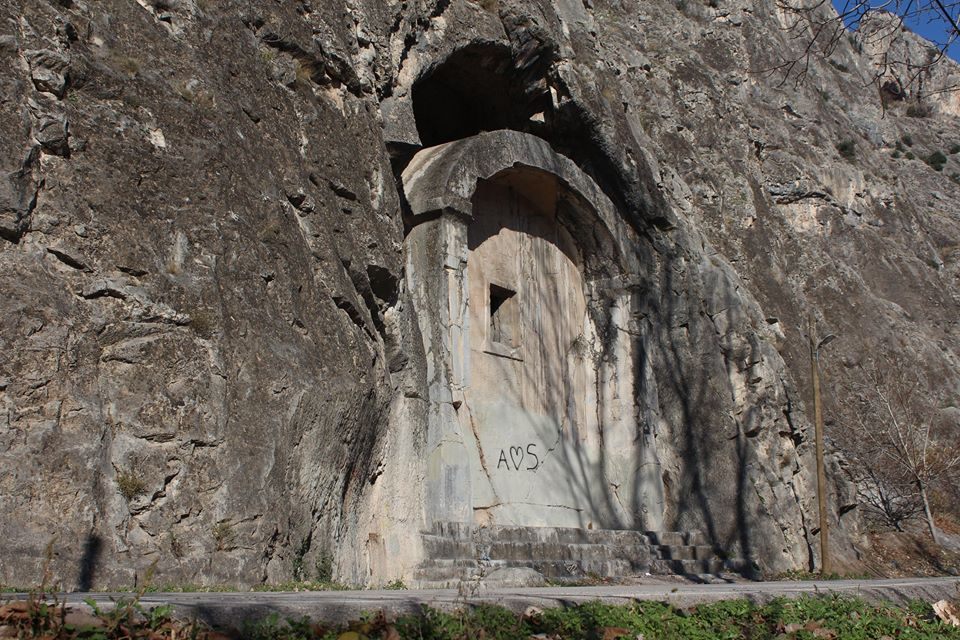
The Mirrored Cave: of the rock tombs around the city, the
most carefully worked. Its name comes from a surface: polished stone that
reflects the light like a mirror. The people, however, explain the name
differently.
Aynalı Mağara. Compare the smoothed, light-coloured surface inside
the arched niche with the raw rock around it — that is where the name comes from.
A rectangular doorway in the middle, stone steps below.
Old Amasya archive.
Graffiti scrawled later on the polished surface can also be seen in the
picture.
📜 What do the documents say?
It is a carefully worked monumental rock-cut tomb, located about 2 km
north of the centre of Amasya. Its popular name comes from the way it
shines with reflected light and serves as a mirror of marble.1
On its surface there is an inscription, half destroyed. In it the words
“Rahip Tes” (rahip means priest) can be read; for this
reason the tomb is thought to have belonged to someone of royal power among
the priests of Komana (Comana) or Zile.2
It was also used as a place of worship and burial in the Byzantine period.
Wall paintings including Jesus, Mary and various figures were made inside
the cave.3
🗣️ What do the people say?
In the folk narrative this cave begins not as a tomb but
as a mirror.
The king of Pontus, they say, had a daughter of legendary beauty. But since
there were no mirrors, she could not see her own beauty. She begged her
father: “Make me a cave that will show my beauty, so that I can gaze at
myself in it.” The king could not refuse his daughter; the Aynalı
Mağara was finished in a few days. From time to time the girl would come and
gaze at her beauty on the wall.3
What comes next is darker. This is the summary of the story in Balaban's
collection:
The ruler has a very beautiful daughter.
She is so beautiful that those who see her face turn to stone;
so she goes about veiled.
To decide who will marry his daughter, the ruler
holds a contest.
She will marry whoever dares to look at her face and does not turn to
stone.
A shepherd, not especially handsome, comes down from the mountain
and asks for her hand.
When the girl lifts her veil, a light covers everything around and
both of them turn to stone.
The beauty of the girl's face is reflected onto the cave, and the rock
takes the name “Aynalı Mağara”.
This section is a folk narrative, not a document. In Balaban's collection
this story is counted among the “turning to stone” narratives
of Amasya and its surroundings — like Kırkkızlar, Gelin Kayası and Analıkızlı.
So it is not a story on its own but a member of a family of narratives.4
One name, two explanations
Here is the interesting thing: the document and the story do not contradict
each other here; they complement each other. Both point to the same thing —
a shining surface.
The documents' explanation
The surface shines with reflected light and serves as a mirror of
marble. That is where the name comes from.1
The story's explanation
The beauty of the face of the girl who turned to stone is reflected
onto the cave, and that is why the rock is called “Aynalı”
(mirrored).4
If you want to see what a legend is for, look here: there is something that
needs explaining — why the rock shines — and the story gives it a reason.
A name half wiped away
RAHİP TES
Half of the inscription on the cave's surface has been destroyed.
This is the part that can be read, as the source gives it.2
Because of these two words, the tomb is thought to have belonged to someone of
royal power among the priests of Komana or Zile.2
In antiquity, Komana and Zile were centres of the temple-state kind; their
high priests held power close to that of kings.
So this tomb probably belonged not to a king but to a priest.
But half the inscription is missing; this page claims no more than that.
What is inside?
4 stepsYou climb up from the ground by stone steps.
165 cmThe height of the graves.
~1 mThe width of the graves.
3 sidesCut free of the rock; a metre of space on each side.
The cave is not simply a hollow carved into the rock: it was separated from the
rock on three sides, leaving a gap a metre wide and as high as the cave.
According to Güler, the reason was to keep out the damp and protect the interior
arrangement.3
You enter through a rectangular doorway. Inside there are two rooms:
one rectangular, one square. The two original graves are in the rectangular
one. The other room was made in the Byzantine period and is decorated
with wall ornament: figures of men and women, Jesus and Mary, and some
inscriptions were carved there.3
This follows the same logic as the Kralkaya Tombs:
a free-standing monument made not by adding stone but by taking stone away.
Güler, too, says that at first sight the cave resembles them, but that it is
“the best worked, made with care and attention”.3
What has been seen at night
Alongside the legend there is also a memorate — that is, events people
believe they have experienced themselves. When Mustafa Güler reports it, he
also writes down the limit of his own testimony:
“I visit it from time to time.
I cannot say that I have gone at night and seen it.
Those who have seen and watched it, and those who have passed by at night, saw
a strange beam of light come out of the cave and drift away.
They say they saw it.
Especially on a pitch-black night; there are also those who say that
horses and donkeys passing in front of it shied and bolted at this
light.”
Mustafa Güler, Amasya Efsaneleri; our translation.3
This account is neither confirmed here nor made fun of.
The person reporting it says “I did not see it” — and that is exactly
why it is worth recording: a memorate documents not so much the truth of an event
as what people believe.
Compare the two stones
Look at the smoothed surface in the middle of the façade, then at the
raw rock right beside it. The difference between them is the whole point of
this monument: one is stone as nature left it, the other is stone made into a
mirror by human hands.1
Come at an hour when the sun strikes at an angle — early morning or late
afternoon. You will see the surface shine. That is where the name comes from.
Then walk round three sides: the cave stands not inside the rock but cut free of
it, with a gap of a metre on three sides.3
You can only see this by walking round it.
While you are there, look for
The boundary between the polished surface and the raw rock.1
The inscription. Half of it is gone; the two words that can be read are
“Rahip Tes”.2
The stone steps. There are four.3
The gap on three sides. The cave is cut free of the rock.3
The two rooms inside. One is the tomb; the other is decorated with
Byzantine wall paintings.3
South, towards the city. The Kralkaya Tombs
are about 2.8 km away; the same technique, the same age.
Key facts
Period
Hellenistic period
Type
Monumental rock-cut tomb1
Whose
According to the inscription, “Rahip Tes”; thought to have been one of the priests of Komana or Zile2
Why the name
The polished surface reflects the light like a mirror1
Later use
Place of worship and burial in the Byzantine period; wall paintings3
Location
North of the city centre, on the road to Ziyaret1
Coordinates
40.672487, 35.8492529 — verified
In the book
Kültürel Miras Boyutuyla Amasya, p. 65
The sources differ on the distance — we hide neither figure.
The book places the cave “about 2 km” north of the
centre;1 the Amasya City Guide and Wikipedia say 3.3 km, on the road
to Ziyaret. Measured from the verified coordinates, it is 2.6 km to the
Clock Tower: so the book's figure is a little short and the others a little long.
The point is not recorded on OpenStreetMap; it was taken from Google Maps'
own entry. Its address is given as Ziyaret, and the road leading up to it is
called “Aynalı Mağara Yolu”. The description that came from
the field also located it “between the town of Ziyaret and Amasya”
and marked it on the map.
Every factual statement on this page rests on one of the sources below.
Titles are given in their original Turkish so that they can be found;
quotations from them are our translations.
Mehmet Fatih Becerik, XIX. Yüzyıl Ortalarında Amasya Şehrinin Sosyo-Ekonomik Yapısı (İstanbul: İstanbul Üniversitesi Sosyal Bilimler Enstitüsü, Doktora Tezi, 2022), 22.
Kani Kuzucular, Amasya Kentinin Fiziksel Yapısının Tarihsel Gelişimi (İstanbul: İstanbul Teknik Üniversitesi Fen Bilimleri Enstitüsü, Doktora Tezi, 1994), 17.
Mustafa Güler, Amasya Efsaneleri (Amasya: Eser Ofset, 1996), 13-16.
Tuğrul Balaban, Amasya Efsane, Menkabe ve Memoratları (Amasya: Amasya Valiliği, 2014), 73. — The motif sequence of the “Aynalı Mağara (Güzelce Kız)” story and its place among the “turning to stone” narratives.
The photograph on this page is taken from the book. The coordinates have
been verified; once a current picture has been added, a “before / today”
comparison will open.