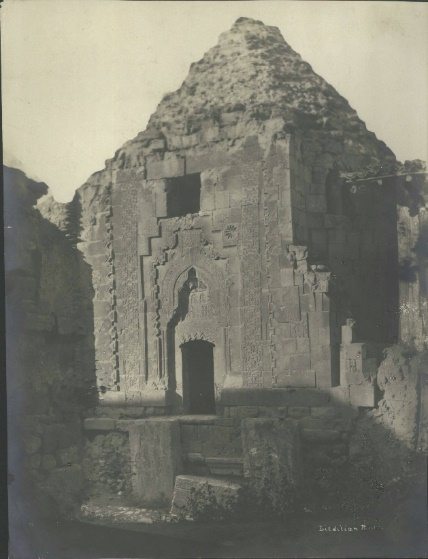
Built for the third conqueror of Amasya.
Four hundred years later a sultan saw it in ruins and
issued a decree at once.
1209 · 1225 · 1228 (disputed)Octagonal, with a conical capRepaired by Murad IV
Square base, octagonal body, conical cap. Above the small door
a muqarnas hood, carved stone panels at the sides and a
rosette.1 This form is the usual shape of the
Anatolian tomb — compare it with the Torumtay Tomb.
TTK Archive (Kültürel Miras Boyutuyla Amasya, Photo 20).
📜 What do the documents say?
The tomb was built for Halifet Gazi, who died in 1225 and is
remembered as the third conqueror of Amasya.2
It is a building with an octagonal body on a square base, covered
inside by a dome and outside by a conical cap.1
When Murad IV came to Amasya and saw the tomb in ruins, he
immediately issued a decree and had it repaired, and ordered a
madrasa to be built beside it.2
In which year was it built?
The book states plainly that there are different views on this.2
This page takes no side.
Around 1209
The tomb may have been built at the same time as the
Halifet Gazi Madrasa, dated 1209.2
1225
The tomb may have been built in 1225, the year Halifet Gazi
died.2
1228
The Site Management Plan gives the date not as an estimate but
as a reading: “it is understood from its inscription that
it was built in 1228”.3
The difference between the three views is twenty years, and it is really a
question: was the tomb ready before the man's death — built, that is, as
part of a complex — or was it built after his death?
The sources do not settle this; nor does this page pretend to.
But there is a difference. The first two views rest on inference:
one starts from the date of the madrasa, the other from the year of Halifet
Gazi's death.2 The third says that it reads the building's own
inscription.3 A reading of an inscription is, in principle,
stronger than an inference; even so, because the book and the other sources do
not use 1228, all three stand together in the Key facts.
A sultan and a ruin
According to the record, which rests on the Amasya historian
Mustafa Vâzıh Efendi, this is how it happened:
When Murad IV came to Amasya and saw the tomb in ruins, he
at once issued a decree and had it repaired, and
ordered a madrasa to be built beside it.
Mustafa Vâzıh Efendi, as quoted in
Kültürel Miras Boyutuyla Amasya.2
What stands out here is the urgency. The record says “at once”:
the sultan sees the building and decides on the spot. Halifet Gazi was a
commander who had died four hundred years earlier — but because he was
remembered with the conquest of the city, the ruined state of his tomb seems to
have been unacceptable to the man who represented the state.
From the bottom up
▢
Square baseThe building sits on the ground on a square base.1
⬡
Octagonal bodyAbove the base the body has eight faces — the move from square to
octagon is the classic solution of the Anatolian tomb.1
◠
Dome insideInside, the ceiling is a dome.1
▲
Conical cap outsideWhat you see from outside, though, is a cone-shaped stone cap.
The dome inside, the cone outside — they are the two faces of the same
covering.1
None of these four steps exists at the Torumtay Tomb:
there the plan is rectangular, and the roof is a barrel vault inside and a flat
roof outside.4 In the same city, fifty years apart,
two completely different choices.
Look at the hood above the door
The tomb's door is small — you have to stoop to go in. Look above it: there is
a muqarnas hood; that is, the inside of the door arch is filled with small
honeycomb cells stacked one above another.
Then look at the carved stone panels at the sides and the rosette.
These are the signature of Seljuk stonework. You can compare their state in the
photograph with their state today: which surface has worn away, which has
been repaired?
Last of all, look up and see the cap. Then walk to the
Torumtay Tomb —
about 260 metres by the verified coordinates.
There is no need to look for a cap there, because there isn't one.4
While you are there, look for
The move from the square base to the octagonal body.1
The conical stone cap.1
The muqarnas hood over the door.
The madrasa beside it. It was built on the order of Murad IV.2
Every factual statement on this page rests on one of the sources below.
Titles are given in their original Turkish so that they can be found;
quotations from them are our translations.
Zeynep Küpra Ketil, Amasya Türbeleri (Konya: Selçuk Üniversitesi Sosyal Bilimler Enstitüsü, Yüksek Lisans Tezi, 2019), 11-12, 24-25.
Mustafa Vâzıh Efendi, Amasya Fetvaları ve İlk Amasya Şehir Tarihi (El-Belâbilü'r-Râsiyye fî Riyâzi Mesâili'l-Amâsiyye) (Amasya: Amasya Belediyesi, 2014), 56-57.
Amasya Harşena Dağı ve Pontus Kral Kaya Mezarları Alan Yönetim Planı ve UNESCO Dünya Mirası Başvuru Dosyası (Amasya: Amasya Belediyesi, 2022), 78. — “2.3.2.4. Bağlantı Noktası 4”: the statement that “it is understood from its inscription that it was built in 1228”, and the description of the tomb's façade.
Tolga Aydın, Amasya Tekkeleri (Bursa: Bursa Uludağ Üniversitesi Sosyal Bilimler Enstitüsü, Yüksek Lisans Tezi, 2019), 61.
The building date is disputed. The sources give three different years; the page shows all three and takes no side. The year of Murad IV's repair, however, is not given in the source available to us.