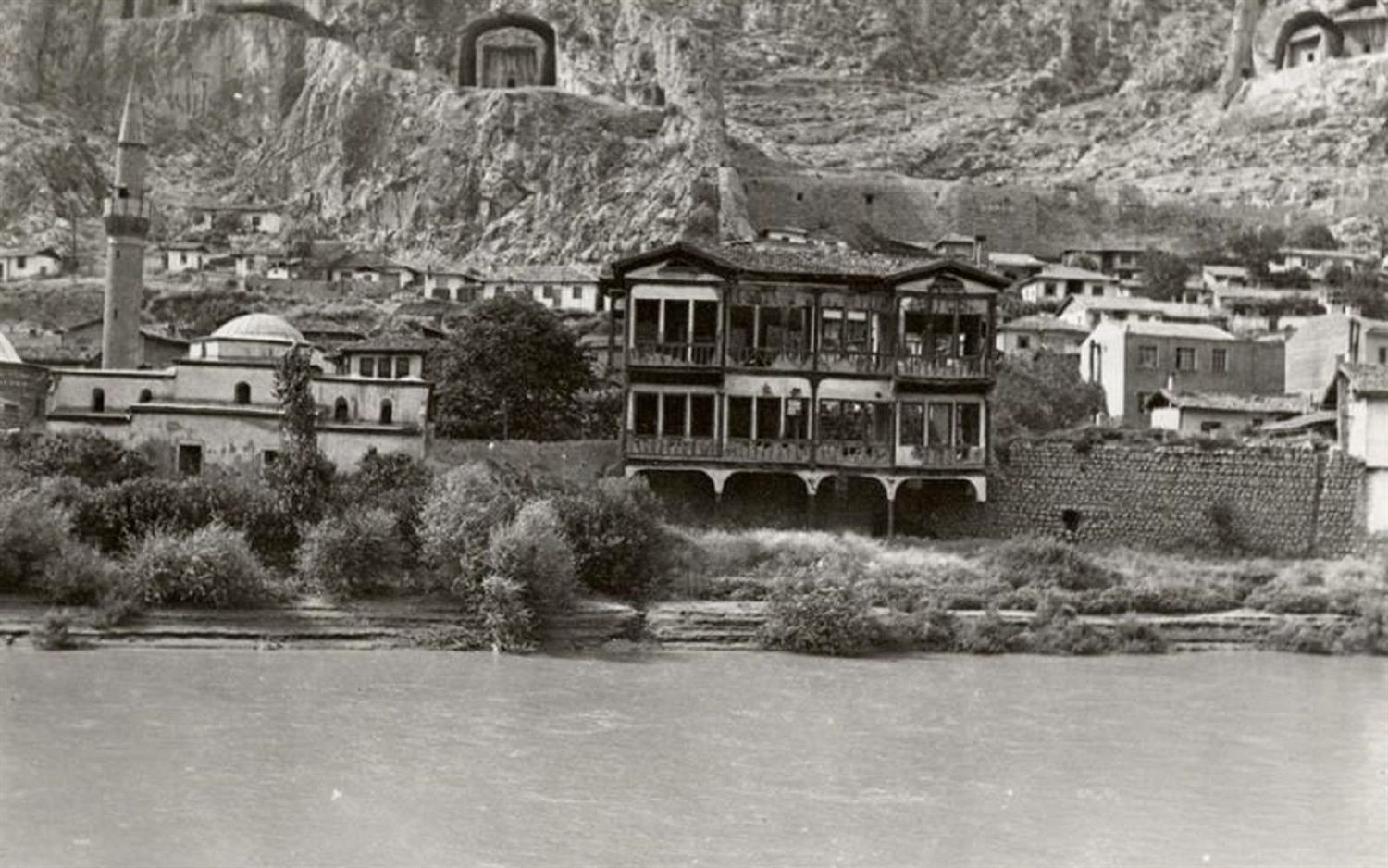
Of the Yalıboyu houses, the one that has come down in
the best condition. And on its arched lower floor facing the river stands
something that no longer exists anywhere else.
1865Defterdar Hasan Talat EfendiA museum today
Hazeranlar Mansion. Two storeys, projecting towards the river; the upper
floor is windowed from end to end. Note the arches on the lower floor —
they are what this page is about.1 On the left, the
Hatuniye Mosque; above, in the rock, the
tombs of the kings.Hüseyin Menç Archive.
📜 What do the documents say?
This building in the Hatuniye neighbourhood is, among the Yalıboyu houses,
one of the mansions that have come down to the present in the best condition,
with the elements of their civil architecture preserved.2
It was built during the governorship (mutasarrıflık) of Ziya Paşa by
the defterdar (provincial treasurer) Hasan Talat Efendi. It was
expropriated and restored in 1985 and is used today as a
museum.3
The arches on the lower floor
The mansion's arched section running along the Yeşilırmak is
the only surviving example of the “boathouse”
(kayıkhane) culture peculiar to Yalıboyu architecture.
That is how the source records it.1
A kayıkhane, as the name suggests, is the place where the boat
(kayık) is kept. So the lower floor of this mansion was not a store-room
or a stable but a section opening directly onto the water.
This alone tells you what Yalıboyu means: these houses were built not merely on
the bank of the river but together with it. The water was not a view but
a door. Today only one of those doors still stands.1
What did it come through?
A timber building does not stay this sound by itself.
The mansion is still standing in spite of:2
The fire of 1915For the timber fabric of Yalıboyu, fire was always the greatest threat.
The Erzincan earthquake of 1939The same earthquake badly damaged the Bimarhane
and left the building disused.
These two are Amasya's two great breaks of the 20th century. Many buildings on
this route were repaired or rebuilt after them — like the
Clock Tower. Hazeranlar, though, has come down
in its original form.
Find the arches that go down to the water
Look at the mansion from the river side — from the opposite bank or from the
Alçak Bridge. Look for the arched section beneath
the timber projection of the upper floor.1
Those arches are not ornament. They are the boathouse — the place where the
boat went in. And according to the source, it is the only surviving example of
this culture in Yalıboyu.1 So if you want to see a door onto the
river in Amasya, this is the only place you can look.
Go inside: today it is used as a museum.3
As you look at the layout of the rooms, remember that this was the house of a
defterdar — the man who kept the state's finances.
While you are there, look for
The arched section running along the river. The boathouse.1
Every factual statement on this page rests on one of the sources below.
Titles are given in their original Turkish so that they can be found;
quotations from them are our translations.
Amasya Harşena Dağı ve Pontus Kral Kaya Mezarları Alan Yönetim Planı ve UNESCO Dünya Mirası Başvuru Dosyası (Amasya: Amasya Belediyesi, 2022), 72.
Mehmet Tektaş, “Hazeranlar Konağı”, TDV İslâm Ansiklopedisi (Erişim 28 Haziran 2026).
Edip Uzundal, Sultan II. Abdülhamid Dönemi'nde Amasya Sancağı (Sosyal, Ekonomik, İdarî ve Demografik Yapı) (Tokat: Gaziosmanpaşa Üniversitesi Sosyal Bilimler Enstitüsü, Doktora Tezi, 2017), 206.