Adım Adım Amasya

The Princes' Route · Stop 10

Madenüs Bridge

Directly opposite the first stop of the route. Its roots reach back to a city gate of Roman times — but the bridge you see today was built in 2010.

Roman in origin Yeşilırmak 2010 reinforced concrete
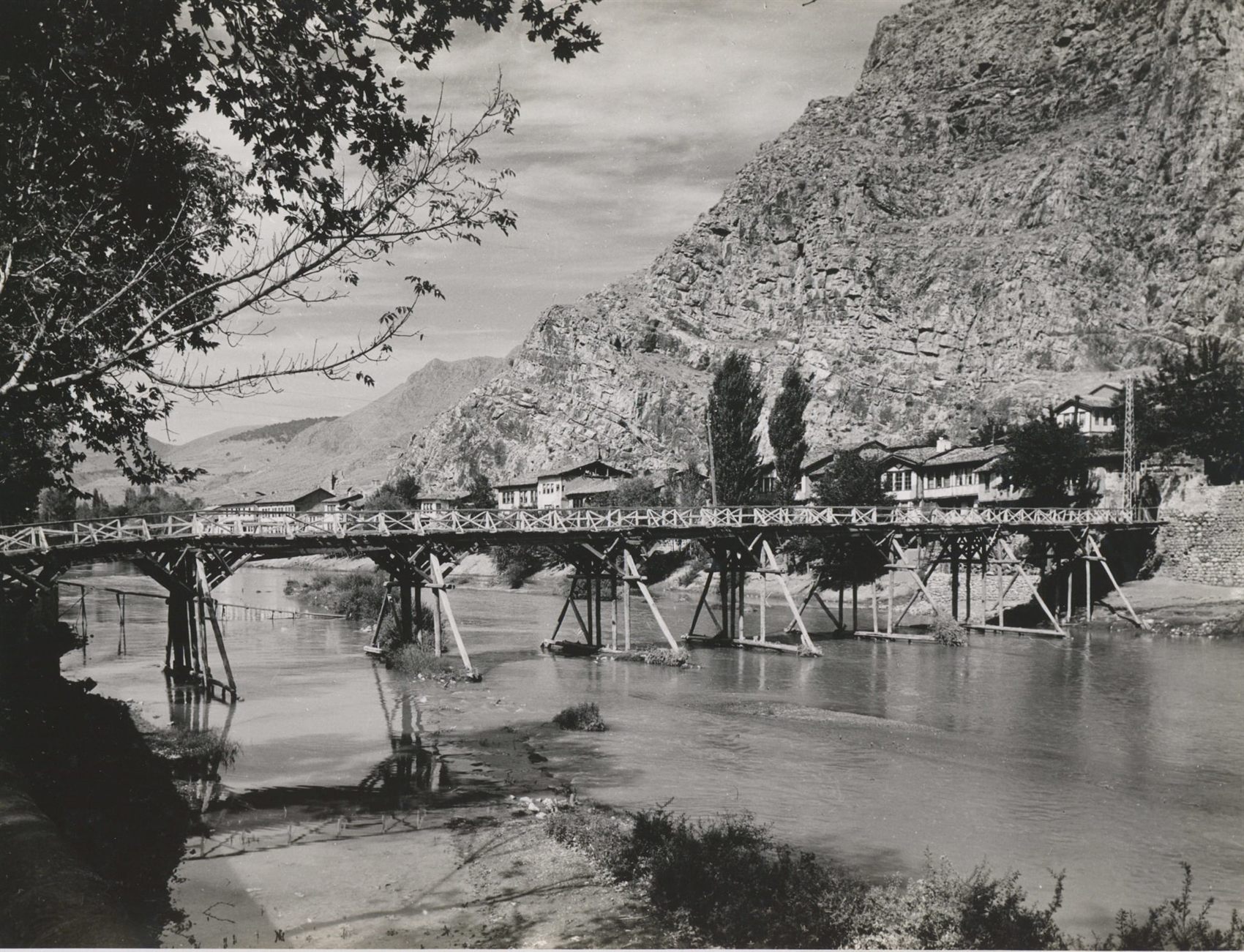
The Madenüs (Maydanoz) Bridge, 1955
The Madenüs Bridge, 1955 — its timber form, before it was pulled down. Sıtkı Karadağ Archive.

In the sources and in popular speech

Mağdinus · Magdenos · Madenüs → “Maydanoz”

The people turned a name that was hard to pronounce into their own language: maydanoz means ‘parsley’.1 Today many in Amasya know this bridge as the Maydanoz Bridge.

📜 What do the documents say?

The bridge stands in front of the Sultan Bayezid II Complex, level with the madrasa. In the sources it appears as the “Mağdinus” or “Magdenos” Bridge, or in popular speech as the “Maydanoz” Bridge.1

The bridge is thought to have been connected with the Meydan Gate, one of the gates leading out of the walled city in the Roman period, and to have formed part of a commercial axis.2

Why was it always being rebuilt? Built mostly of timber over the course of history, the bridge was one of the structures most vulnerable to the floods of the Yeşilırmak.1 This stop is as much the story of a struggle with a river as the story of a bridge.

The same crossing, three bridges

The place did not change; the bridge changed three times.3

While you are there, look for

Key facts

Origin
Connected with the Meydan Gate of the Roman period2
Names
Mağdinus · Magdenos · Madenüs · popularly “Maydanoz”1
Position
In front of the Bayezid II Complex, level with the madrasa1
Present bridge
2010, reinforced concrete3
Earlier
Timber until 1968; then an iron footbridge on concrete piers3
Location
40.651408, 35.826138 — verified against OpenStreetMap
In the book
Kültürel Miras Boyutuyla Amasya, p. 60

📍 Open on the map

Sources

Every factual statement on this page rests on one of the sources below. Titles are given in their original Turkish so that they can be found; quotations from them are our translations.

  1. Gediz Urak, Amasya'nın Türk Devri Şehir Dokusu ve Yapılarının Analiz ve Değerlendirilmesi (Ankara: Gazi Üniversitesi Fen Bilimleri Enstitüsü, Doktora Tezi, 1994), 504.
  2. Kani Kuzucular, Amasya Kentinin Fiziksel Yapısının Tarihsel Gelişimi (İstanbul: İstanbul Teknik Üniversitesi Fen Bilimleri Enstitüsü, Doktora Tezi, 1994), 30.
  3. Amasya Harşena Dağı ve Pontus Kral Kaya Mezarları Alan Yönetim Planı ve UNESCO Dünya Mirası Başvuru Dosyası (Amasya: Amasya Belediyesi, 2022), 62.