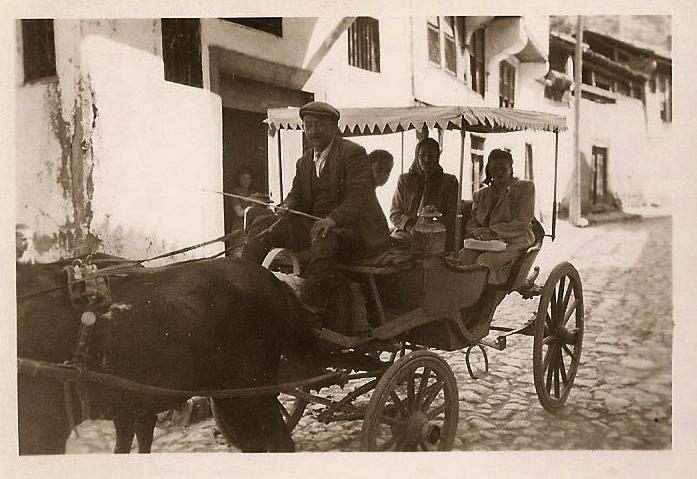
Who ran this place a hundred years ago?
Osman Fevzi Olcay of Amasya describes this bathhouse as well when he writes
about the Sofu-zade neighbourhood, where he was born and grew up. What he tells is
not a document but a memoir; yet no other source shows the daily life of a
bathhouse so closely.3
“Karabaracıoğlu Hacı Ali Hafız Ağa, the bathhouse keeper: he was a
charitable, generous, neighbourly, very clean and noble-hearted man.
Hacı Hafız Ağa ran the Sinan Bathhouse at Selağzı and the Mustafa Bey
Bathhouse in front of the Bimarhane. Both of these bathhouses were under Hafız
Ağa's management, and the women's section was run by his wife, Ayşe Hanım.
In the evening, once the bathhouse had closed, the attendants of both bathhouses
would stoke the furnace on the night watch, as its state required.”
Osman Fevzi Olcay, Amasya Hatıraları.3
Olcay also sketches the childhood geography of the neighbourhood: the open ground
in front of the Bimarhane, the Mustafa Bey Bathhouse and the Çevikçe School was
their “main playground”. On the corner directly opposite the bathhouse
stood the house of Mumcu Hakkı (Hakkı the candle-maker).3
“Between the Mustafa Bey Bathhouse and the furnace part of the bathhouse
there was a raised coffee house. In the evenings we would go up to this coffee
house now and then.
The regulars of the coffee house were mostly fanciers of Indian hens and Indian
cocks, and hunters. They would gather in this coffee house every night without
fail, and on some nights they would even bring their cocks and set them fighting
each other.”
Osman Fevzi Olcay, Amasya Hatıraları.3
Look for the furnace
The least visible but hardest-working part of a bathhouse is the furnace
(külhan) — the firing place where the water is heated. According to Olcay,
this one's furnace was stoked on a night watch, as its state required:3
that is, someone sat by the fire all night.
Walk round to the back of the building. The furnace side is usually the low,
soot-stained part, away from the street; the fuel goes in there. The “raised
coffee house” that Olcay climbed up to as a child stood between the bathhouse
and the furnace.3
The coffee house has gone, and so have the cocks. But that gap between the
bathhouse and the furnace is still there.
How many bathhouses were there in Amasya?
According to the yearbooks (salname) of the province of Sivas, the number of
bathhouses in Amasya, the seat of the sancak, ran as follows:1
| Yearbook | Bathhouses |
|---|
| 1875 | 19 |
| 1876 | 22 |
| 1880 | 19 |
| 1882 | 14 |
| 1883 | 14 |
| 1888 | 14 |
In 1903 and 1907, 130 inns and 54 bathhouses were recorded across the whole
sancak of Amasya.1
The four bathhouses on this route are what is left of that number.
Ottoman bathhouses were also told apart by type: those with separate sections for
women and men were called “çifte hamam” (double bathhouse), those in
the neighbourhoods set aside for women alone “avret”, and those built
for men in the bazaar “rical hamamı”.1